
ServiceNow Brings Its Autonomous Workforce to Every Department — AI That Acts, Not Just Advises
ServiceNow Brings Its Autonomous Workforce to Every Department — AI That Acts, Not Just Advises
At Knowledge 2026, ServiceNow expanded its Autonomous Workforce: role-scoped AI specialists that complete entire business processes across IT, CRM, HR, and security. We unpack the rollout timeline, the vendor-reported results, the orchestration layer, and how to think about adopting it.
Enterprise AI is shifting its center of gravity from advising to acting. The clearest sign of that shift is the expanded Autonomous Workforce that ServiceNow unveiled at its annual Knowledge 2026 event in May 2026. Instead of AI that merely answers in a chat window, ServiceNow is putting "AI specialists" that finish a business process end to end into every major function — IT, sales, HR, finance, legal, procurement, and security. Here we walk through what was announced, why it matters, and how it lands in day-to-day work, from a practitioner's point of view.
A declaration that "advisory AI" is over
Amit Zavery, President and Chief Product Officer at ServiceNow, framed the announcement bluntly.
"Advisory AI has run its course. Enterprises need AI that senses, decides, and securely acts."
The line doubles as a verdict on the last two years of the AI boom. Many companies adopted conversational AI as a "smart advisor," but a human still did the final work by hand. Summaries and drafts got faster, yet the system rarely reached the finish line — closing the ticket, moving the deal forward, resolving the incident. What ServiceNow is proposing is to hand that last step to the machine.
Specialists built to "complete the work," across functions
At the heart of the announcement is a set of AI specialists designed around roles. IT operations, customer relationship management, employee service (HR), and security and risk each get a dedicated AI.
Three things separate them from task assistants or chatbots. They are role-scoped. They are governed. And they are embedded in proven enterprise workflows. ServiceNow says these specialists can triage a security incident, resolve an HR case, or close a sales quote autonomously — while leaving a full audit trail behind.
Availability is staged by function. The table below organizes the timeline ServiceNow disclosed.
| AI specialist | Primary scope | Availability |
|---|---|---|
| L1 IT Service Desk / CRM / Employee service | First-line, customer, HR cases | Available now |
| IT AI specialist | Broad IT operations | June 2026 |
| Security & Risk AI specialist | Threat response, risk | Preview June 2026 → GA September 2026 |
The table draws the line between what you can use now and what is coming. First-line and customer work is already in production; the deeper, higher-stakes security domain expands in stages. For anyone evaluating adoption, that sequence is the realistic roadmap.
The numbers point to "faster than humans"
The effects are already being described in concrete figures. ServiceNow's internal AI specialist resolved IT service desk cases 99% faster than human agents. Docusign is targeting autonomous resolution of 90% of all IT tickets, and Honeywell reports its AI assistant has eliminated the majority of service desk conversations. The City of Raleigh, North Carolina, says AI now deflects 98% of employee requests, saving the equivalent of one month of staff time.
All of these are figures published by ServiceNow and its customers, not independent third-party verification, so they should be read with that caveat. Even so, the direction is unambiguous. AI's role is moving from "reduce the volume of tickets" to "take over the work itself."
Across the industry, though, autonomous agents still vary in how reliably they finish a task. In First Page Sage cross-platform benchmarks, task completion rates for leading agent platforms range from 65% to 86% (as of Q1 2026).
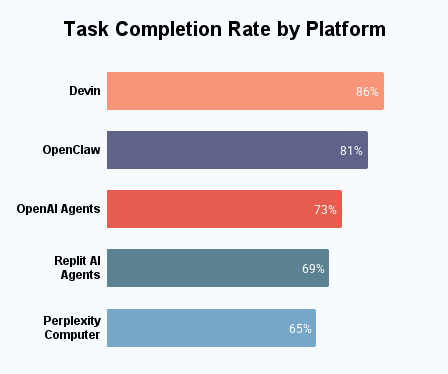
ServiceNow's "99% faster" is a figure from its own bounded domain; whether general-purpose agents can finish work without dropping the ball is something to judge function by function.
The mechanics: an orchestrator that coordinates, a control tower that governs
What underpins the Autonomous Workforce is not the individual agents but the layer that binds them. ServiceNow's AI agents are described as interpreting intent, making decisions, and executing actions within bounded autonomy. For work involving multiple agents, an AI Agent Orchestrator coordinates task ownership, sequencing, and data flow, handing off predictably within enterprise policy.
The linchpin of governance is the AI Control Tower, which defines which decisions require human approval and where to escalate in situations outside an agent's parameters, all under centralized monitoring. In a network incident, for example, an agent detects the issue, gathers data from monitoring systems, assesses business impact, identifies the root cause, drafts a remediation plan, executes the fix after human approval, and updates the documentation — autonomously. Organizations report 30–50% reductions in process time from these deployments.
If you were to run this yourself, where do you start
What matters here is not the flashiness of the tool but the design choice of how much to delegate. The first thing to decide, in practical terms, is where to keep human approval. High-value approvals, customer commitments, and anything carrying legal risk are best kept human-in-the-loop for now.
Next, build escalation paths and audit trails in from the start. "AI did it faster" is not enough; being able to reconstruct why a decision was made later is what earns frontline trust and satisfies auditors. Finally, think in terms of embedding into existing workflows. Slotting AI into work that already runs — rather than operating a separate AI silo — makes both adoption and ROI easier to read. ServiceNow's emphasis on "embedded in proven workflows" is precisely where the contest is won.
The outlook: from "a single AI" to "governed coordination"
ServiceNow is not keeping this vision in-house; it is wiring it to major players including Microsoft, NVIDIA, Lenovo, AWS, and Google Cloud. With Microsoft, the governance framework is being extended across each other's agent ecosystems. Microsoft's Charles Lamanna put it this way: "One of the most important things we can do for enterprises is bring intelligence and action together in a secure, connected way."
The axis of competition is no longer the cleverness of a single AI. It is whether you can coordinate many agents safely and keep them running inside the company's rules — that governance is the next battleground. The question for your own organization is simple: which process could you first trust to be "executed"?
Key takeaways
At Knowledge 2026, ServiceNow rolled out AI specialists that finish work end to end across major departments. IT, CRM, and employee service are available now; broad IT operations arrive June 2026; security and risk goes from a June preview to general availability in September. Internally, resolution was 99% faster than humans, and Docusign targets 90% autonomous resolution of all IT tickets (all vendor-reported). The keys are the orchestrator that coordinates agents and the control tower that governs decisions, approvals, and audit. Adopters should start their design from three points: where to keep human approval, escalation and audit trails, and embedding into existing workflows.
Sources
This article was independently written and edited by the Business Age Editorial Team based on the multiple verified sources below. See each source for full details.
- Fortune (ServiceNow Knowledge 2026 / May 5, 2026)Read the original →
- Kellton "ServiceNow AI Agents and Agentic Workflow Automation 2026"Read the original →
PR

Related
Related articles

SAP Bets on the "Autonomous Enterprise": When ERP Moves From Advice to Action

AI Agents Hit 72% Production — Yet Most Firms Still Can't Show the Value

Microsoft's Seven In-House MAI Models: A Lower-Cost Bid to Cut Its OpenAI Dependence

How "Delegating" Software Development Changed: Inside the Claude Code × Cursor Stack

The Day MCP Became AI's Universal Standard: What 10,000 Servers Mean for the Enterprise

Prompting in the GPT-5 Era: Why Over-Specifying Now Hurts Accuracy (2026)
Categories
Browse other categories





Get the latest business methods, first.
We share new articles and notable tools and trends on social.