
How "Delegating" Software Development Changed: Inside the Claude Code × Cursor Stack
How "Delegating" Software Development Changed: Inside the Claude Code × Cursor Stack
85% of developers now use AI daily, and the best teams run two agents, not one. How do you split work between Claude Code and Cursor? We read the primary data and field productivity metrics for the AI-era developer.
"We already let AI write the code." This is no longer the story of a few cutting-edge teams; it has become the standard on the development floor. In JetBrains' developer survey (2025), about 85% of developers said they use AI tools for coding on a daily basis. The question is no longer "whether to use AI." It has shifted to "which AI, and how do you combine them?"
The answer taking hold in the field is a style of "splitting" work between two AI coding agents: Claude Code and Cursor. Why run two instead of settling on one? And what actually changes when you use them? Let us read it from primary data and voices on the ground.
"Writing with AI" Is a Given — the Game Is the Combination
First, the lay of the land. According to a survey of 40 working engineers by AI Builder Club (June 2026), 65% of engineers said they routinely run two AI coding agents in tandem. Rather than consolidating onto one all-purpose tool, they switch between tools with different roles — this has become the realistic choice of capable developers.
The most common pairing was Cursor and Claude Code, adopted by 25% of respondents. And notably, this two-tool cohort reported the highest self-rated productivity of any setup tested.
Running Two Is the Most Productive — What the Data Shows
In the same survey, engineers running Cursor + Claude Code reported shipping roughly 2.5x more features per week than single-tool users (self-reported, and worth noting this is a survey of around 40 respondents).
The performance gap between tools also shows up in data from Faros AI, an engineering-intelligence firm.
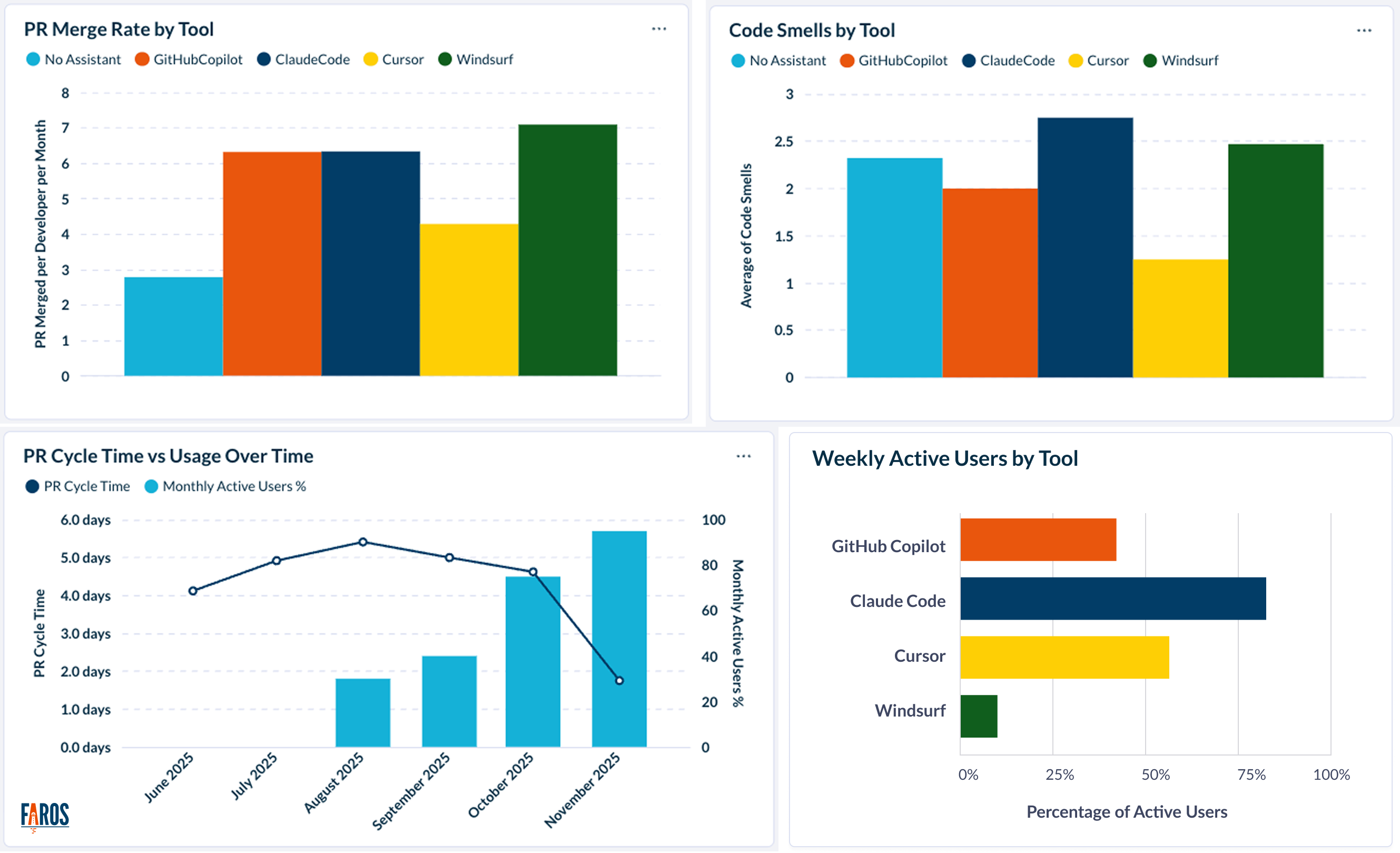
The dashboard makes one fact clear: teams using AI assistants merge distinctly more PRs per developer per month than teams that do not. On weekly active users, Claude Code sits at the top, with Cursor close behind. Judged not by "did you adopt it" but by "is it actually used," these two stand a head above the rest.
Cursor Is an "Extension of the Hand"; Claude Code Is a "Partner You Delegate To"
So how do you actually split the two? The division of roles the survey describes is clear. In one engineer's words —
「Two tools, two different jobs.」
Cursor handles the "extension of the hand": predicting the next few lines with a tap of the Tab key, or making local edits via natural language ("rewrite this function like so"). Responses come back in under 0.1 seconds, lifting the raw speed of writing code.
Claude Code, by contrast, lives in the terminal and, given a goal, autonomously drives multi-file refactors and ships entire features — a "partner you delegate to." With a well-maintained "CLAUDE.md" capturing project context, its task-completion rate reaches around 70%. Cursor writes the fine lines fast; Claude Code clears a whole tedious feature. That division of labor is the heart of running two.
Why It Doesn't Consolidate Into One
The natural question is "why doesn't this consolidate into one ultimate tool?" Behind it is a structural shift: AI development tools are moving toward a "composable stack." The layers of development — editing, execution, review — are each handled by the tool best at them. Combining the best per role proves faster and more reliable than one company owning everything.
Indeed, Cursor, Claude Code, and OpenAI's Codex are not collapsing into one by killing each other off; they are coexisting across separate layers. Cursor was named a Leader in the 2026 Gartner Magic Quadrant for enterprise AI coding agents, and its annual recurring revenue is reported to have reached roughly $1 billion in November 2025 and headed toward $2 billion in early 2026. There is no sign of the market converging on a single winner; if anything, each player is sharpening its role on the assumption of being combined.
"How Is It in Practice" — Cost and the Real Pitfalls
In practical terms, running two is not free. Cursor Pro runs around $20/month and Claude Code's higher tier around $200/month — using both fully comes to roughly $220/month (AI Builder Club survey, June 2026). Per head it is not cheap, but if weekly shipped features rise 2.5x, the return on an engineer's salary is easy to justify, the field reports.
There are pitfalls, though. In mid-2025, usage caps on Claude Code led to mid-workflow lockouts, and pricing-model changes drove users away from some tools. Misjudge "which plan, and how far to push it," and costs spike or work stalls. The perspective an adopter should hold is less about which tool is superior and more about the design question: which stage of your development do you delegate, to which tool, and how far? Separate the "write fast" part from the "delegate wholesale" part, and always keep a checkpoint where a human reviews AI-written code. Only with that operating design does running two actually pay off.
Toward an Era That Tests "How You Delegate," Not the Tool
Looking ahead, the competition in AI coding has fully shifted its axis from "which tool is strongest" to "how you combine and how you delegate." With 85% using AI daily and two-thirds of capable teams running two, what makes the difference is not the choice of tool but the design of delegation.
What is tested is the ability to articulate a goal and hand it to AI, and the reviewing eye to judge what comes back. The faster AI makes your hands, the more the work left to humans drifts upstream — to "deciding what to build and judging the result." The next step is to inventory your own development process once and decide where to draw the line between "write fast" and "delegate wholesale."
Key takeaways
About 85% of developers use AI daily (JetBrains, 2025), and 65% of working engineers run two agents (AI Builder Club, June 2026, 40 respondents). The most common pairing is Cursor + Claude Code; this cohort reported the highest self-rated productivity, shipping roughly 2.5x more features per week. Cursor writes fast as an "extension of the hand"; Claude Code clears a whole feature as a "partner you delegate to." Despite pitfalls like the ~$220/month cost and usage caps, the decisive point is not which tool wins but the design of which stage you delegate, to which, and how far. The tools are in place; what remains is to decide how to delegate.
PR

Sources
This article was independently written and edited by the Business Age Editorial Team based on the multiple verified sources below. See each source for full details.
- AI Builder Club (survey of 40 working engineers, June 2026)Read the original →
- Faros AI (AI coding tool comparison data)Read the original →
- The Next Web (Cursor funding and valuation)Read the original →
PR
Related
Related articles

SAP Bets on the "Autonomous Enterprise": When ERP Moves From Advice to Action

ServiceNow Brings Its Autonomous Workforce to Every Department — AI That Acts, Not Just Advises

AI Agents Hit 72% Production — Yet Most Firms Still Can't Show the Value

Microsoft's Seven In-House MAI Models: A Lower-Cost Bid to Cut Its OpenAI Dependence

The Day MCP Became AI's Universal Standard: What 10,000 Servers Mean for the Enterprise

Prompting in the GPT-5 Era: Why Over-Specifying Now Hurts Accuracy (2026)
Categories
Browse other categories





Get the latest business methods, first.
We share new articles and notable tools and trends on social.