
How AI Search Rewired the Buying Journey — and Why Brands Now Compete to Be Cited
How AI Search Rewired the Buying Journey — and Why Brands Now Compete to Be Cited
AI chat is the new buying front door—ChatGPT 53.1%, Claude 21.1% in the U.S. (June 2026). As 94% of B2B buyers use gen-AI, visibility shifts from ranking to citation. We break down what brands should change now.
When people shop now, the first thing they open is often not a search engine but an AI chat. In 2026, that shift is no longer the exception—it's the mainstream. Buyers ask the AI, then choose among the handful of brands it names. The era of scanning ten blue links from the top down is quietly ending. For marketers, the question has moved from "what's my ranking?" to "will the AI cite me?"
The Front Door Became a Chat
Start with the map of the market. According to First Page Sage, U.S. generative-AI chatbot usage share as of June 2026 looks like this.
| Service | Share (U.S., as of June 2026) |
|---|---|
| ChatGPT | 53.1% |
| Claude | 21.1% |
| Google Gemini | 13.1% |
| Microsoft Copilot | 8.7% |
| Perplexity | 2.7% |
| Grok | 0.6% |
*Source: First Page Sage, "Top Generative AI Chatbots by Market Share" (U.S., as of June 2026).
The provider also published a time-series chart that makes the trajectory of this map clear.
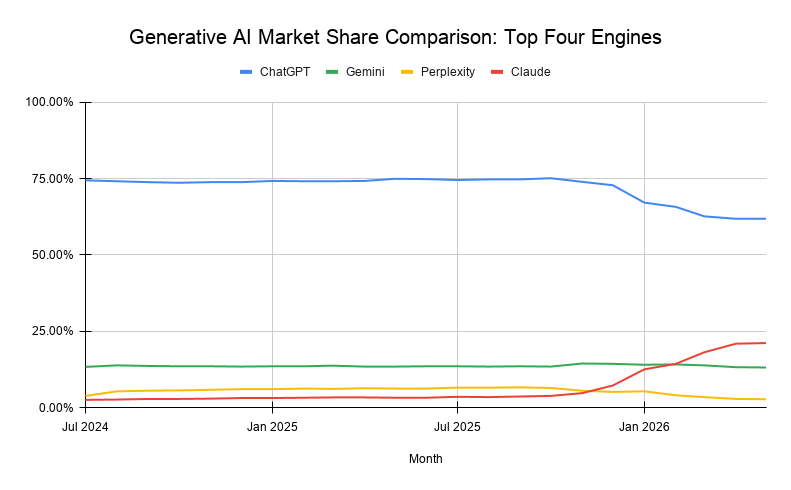
You can see at a glance that ChatGPT, while still leading, has gradually ceded share as Claude has climbed steadily.
ChatGPT holds a majority while Claude follows above 20%. What matters more than the ranking is that this much usage is flowing into "shopping research." OpenAI puts ChatGPT's weekly users at around 900 million (as of February 2026). That enormous front door has begun owning the first step of the purchase.
How Buyer Behavior Changed
The shift is sharp in B2B too. In 6sense's 2025 buyer study, 94% of B2B buyers used generative AI somewhere in their purchase process (as of November 2025). "Consult the AI before talking to a human" is becoming the default move.
Quality matters as much as volume. Per Adobe Digital Insights, during the 2025 holiday season AI-referred traffic converted 31% better than non-AI traffic, and AI referral traffic grew 693% year over year (both as of January 2026). It isn't just more visitors—it's visitors who intend to buy.
Why the higher conversion? AI organizes vague intent and narrows the field to a few candidates before presenting them. Users hand the early comparison work to the AI and arrive at a brand already half-decided. That's why the traffic is worth more. It's a move from search's "broad and shallow" to AI's "narrow and deep."
The Rules of Visibility Got Rewritten
This is where "do you get cited?" bites. Ranking high in traditional SEO no longer guarantees an AI citation. In AirOps' 2026 research, 59.6% of AI citations came from pages that don't rank in traditional top results, and 85% of brand mentions sat on third-party pages rather than the brand's own site (as of 2026).
"About 60% of AI citations come from pages that don't rank at the top of search."
That's a heavy fact. However much you polish your own site, what the AI references may be reviews, comparison articles, forums, and industry media—"someone else's turf." Visibility is increasingly decided not inside your domain but by the total volume of mentions scattered across the web.
Google isn't exempt. In Conductor's 2026 benchmarks, 25.11% of Google searches surface an AI summary (AI Overviews). Users get the answer from the AI summary before clicking a single link. No wonder 54% of marketers plan to start generative engine optimization (GEO) in the next three to six months (eMarketer, as of January 2026).
What to Change to "Get Cited"
So what should practitioners watch? First, stop using your site's ranking as the only success metric. You need to track separately whether—and in what context—the AI cites you. Ranking and AI visibility are no longer the same thing.
Second, treat your reputation on third-party turf as an asset. Review sites, comparison pieces, industry media, expert voices—that's what the AI references. You need to build clear, structured, fact-based information that is easy to cite as a primary source, beyond your own walls.
Third, design content that's easy for AI to summarize. Lead with the conclusion, attach a time point to every number, and translate jargon. Writing that's easy for humans to read is easy for AI to cite, too. Not tricks, but the quality and clarity of the information itself now translate directly into visibility.
Designing for the Visibility Ahead
Once the front door moves to chat, a brand's battle shifts from "stand out in the results" to "have your name inside the AI's answer." Ranking isn't meaningless, but on its own it increasingly fails to put you in the buyer's field of view.
What's being tested is a composite strength: how widely the web recognizes you as a trustworthy source worth citing. Can you become a "cited entity" not just through on-site optimization but including third-party esteem? That's the dividing line of marketing from here.
Key Takeaways
- The buying front door moved to AI chat. U.S. generative-AI chatbot share: ChatGPT 53.1%, Claude 21.1%, Gemini 13.1% (First Page Sage, as of June 2026). ChatGPT weekly users ~900 million (OpenAI, as of February 2026).
- 94% of B2B buyers used gen-AI in purchasing (6sense, as of November 2025). AI-referred traffic converted 31% better and grew 693% YoY (Adobe, as of January 2026).
- The visibility rules changed: 59.6% of AI citations came from non-top-ranking pages and 85% of brand mentions sat on third-party pages (AirOps, as of 2026). 25.11% of Google searches show AI Overviews (Conductor, as of 2026).
- 54% of marketers plan GEO within three to six months (eMarketer, as of January 2026). Practice shifts from "ranking" to "getting cited"—third-party reputation and AI-summarizable, clear information are the keys.
Sources
This article was independently written and edited by the Business Age Editorial Team based on the multiple verified sources below. See each source for full details.
- First Page Sage "Top Generative AI Chatbots by Market Share"Read the original →
- omnibound "AI Search Statistics 2025-2026" (compiling 6sense/Adobe/OpenAI/AirOps/eMarketer/Conductor)Read the original →
PR

Related
Related articles

When AI Does the Shopping: Agentic Commerce and the Redesign of Marketing

The Age of AI That Buys for You: Visa and Mastercard Moved on the Same Day

From Ranking to Being Cited: How GEO Rewrites Marketing in the AI Search Era
Shopify Puts AI on Every Screen: Running a Store in the Agent Era

The Year AI Video Got Production-Ready: Veo and Where It Fits

How TikTok Shop Changes Selling: ~70% of Sales Come From Video and LIVE—Playbook for Discovery Commerce
Categories
Browse other categories





Get the latest business methods, first.
We share new articles and notable tools and trends on social.