
How TikTok Shop Changes Selling: ~70% of Sales Come From Video and LIVE—Playbook for Discovery Commerce
How TikTok Shop Changes Selling: ~70% of Sales Come From Video and LIVE—Playbook for Discovery Commerce
TikTok Shop, which launched in Japan in June 2025, grew to 50,000+ sellers and 200,000+ creators in six months. About 70% of its GMV comes from video and LIVE streams—"discovery commerce." On this storefront, whose premise differs from search-led EC, we lay out concretely how brands and individuals should compete.
"Search for a product, compare, and buy." That was the conventional wisdom of online shopping. But a storefront that overturns that premise is now growing fast in Japan: TikTok Shop, which fully launched in the country on June 30, 2025. Here, people do not come to look for what they want. They watch videos, feel "I want this," and buy on the spot. Purchases arise not from search but from content—what is called "discovery commerce."
Its power shows in the numbers. According to six-month data released by TikTok Japan on February 3, 2026, about 70% of TikTok Shop's gross merchandise value (GMV) is generated by videos and LIVE streams. It is creators' videos and live broadcasts—not the conventional listing pages that line products up in a grid—that have become the lead actor in sales.
This structure significantly changes the standard playbook of marketing and EC. Raising search rank, optimizing product pages—measures premised on people coming to look—are not the lead here. Below, we grasp TikTok Shop's launch in numbers, then dig into why video and LIVE sell, and how brands and individuals should compete.
From "search and buy" to "watch and want"
In conventional EC, purchases arise from "people whose demand has surfaced." Someone who realizes they want something searches, compares and buys. So sellers have focused on search optimization and ads to be found at that moment.
Discovery commerce reverses this order. It introduces products, through entertaining videos and LIVE streams, to people who have not yet realized they want them—creating the demand itself on the spot. It resembles TV shopping, but the decisive difference is that the presenters are countless creators; if viewers like something, they immediately follow and share it, and the algorithm delivers it to more similar people. A single video can send a no-name product surging—that kind of breakout happens on this storefront.
The six-month launch in numbers
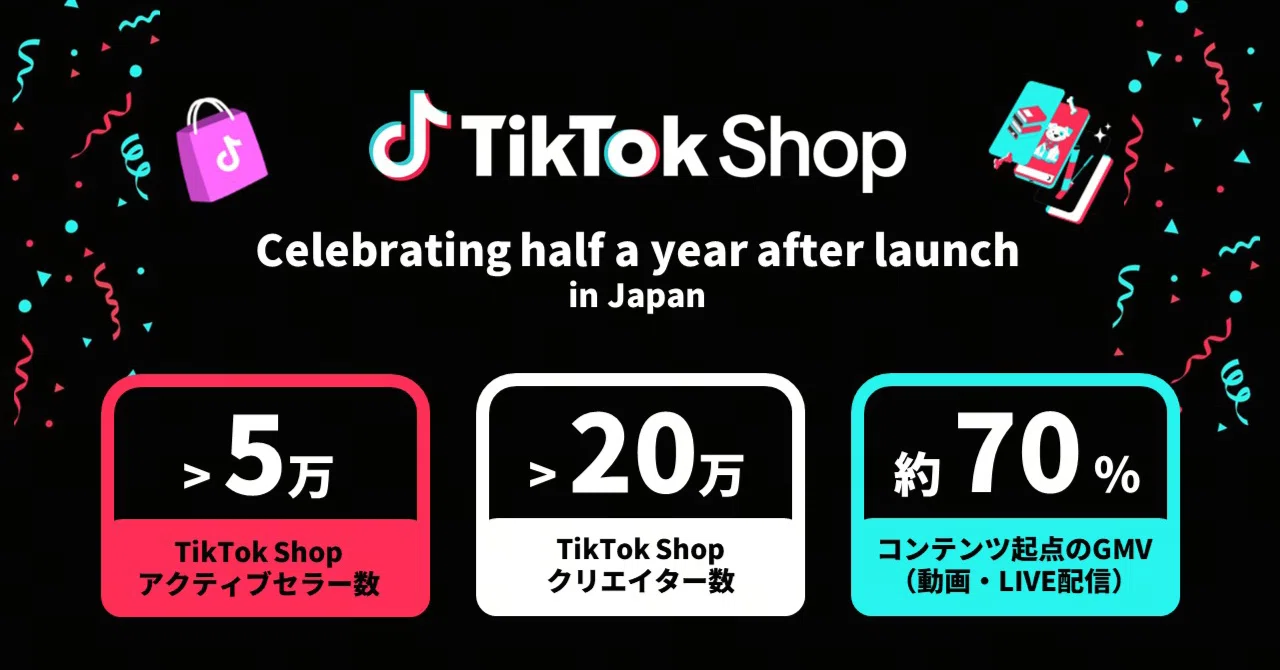
First, the momentum of the launch.
| Metric (TikTok Shop Japan) | Figure |
|---|---|
| Service launch | June 30, 2025 |
| Share of GMV from video/LIVE | ~70% |
| Registered sellers (six months in) | 50,000+ (about 3x at launch) |
| Selling creators | 200,000+ |
In six months sellers roughly tripled and creators surpassed 200,000—a supply-side ecosystem thickening rapidly. On market growth, a private market white paper (studio15, February 2026) projects that Japan's TikTok Shop market could reach annual GMV of around ¥128.3 billion by the end of 2026 (a third-party projection only). Even allowing for the high multiples of the early launch phase, there is a range of confidence around the figure—but there is no doubt this is a fast-growing area.
Why video and LIVE sell
The reason video and LIVE account for 70% of GMV is that they "sell the context along with the product." A spec table on a product page can nudge people who already want something, but it struggles to move those who don't. A video in which a creator actually uses, talks about and shows a product conveys the whole context of "in what situation, and how it helps." Before judging the product's merits logically, viewers react emotionally—"if this person uses it," "with this use case, maybe for me too."
LIVE streaming is even more powerful. It answers questions in real time, shows remaining stock and limited-time prices, and lets viewers see others buying. It recreates, interactively and at the individual level, the "buy now or miss out" immediacy that TV shopping honed over decades. Because payment completes within the app, the heat of "I want this" can be carried through to purchase before it cools. This low leakage of buying intent is what lifts the conversion rate of discovery commerce.
The playbook for sellers and brands
So what should sellers do? First, switch your mindset from "listing" to "content production." Tidying up product pages alone won't get you found here. Building a system to produce your own videos—or to broadcast continuously in partnership with creators—is the real engine of customer acquisition. You need the mindset of redirecting part of the ad budget toward creator fees and running LIVE streams.
Second, design collaborations with well-matched creators. More important than follower count is whether they can naturally speak to your product's context and whether their audience overlaps with yours. Rather than one big tie-up, testing small with multiple creators and concentrating investment on the combinations that grow tends to work better on this storefront. Third, strip out the "ad smell." TikTok viewers are sensitive to a hard sell, and obvious ads get scrolled past. A tone closer to real usage and honest impressions sells better in the end. An authentic, life-sized clip breaks out more than a heavily produced commercial—understanding that paradox is the key.
What it means for SMBs and individuals—and the caveats
The appeal of this storefront is that it opens chances to sellers with little capital or name recognition. Even without a big company's ad budget, one resonant video lets the algorithm push its spread. Small local businesses with physical stores and individual creators can reach nationwide demand with just inventory and broadcasting power. Initiatives for local sellers such as "TikTok Shop Local" have also begun.
There are caveats, though. Because it is content-led, sales are hard to stabilize; even if one clip goes viral, momentum fades without continuous output. You also need to watch the risk of fee and platform-rule changes, and the erosion of trust from overly aggressive hype selling. Discovery commerce is a storefront where "the upside is big if you hit, but hitting repeatedly takes a system." Rather than chasing a one-off viral moment, whether you can keep a creator-collaboration and content engine running is the dividing line for winning over the long term.
Key takeaways
- TikTok Shop launched in Japan on June 30, 2025. About 70% of its GMV comes from video and LIVE streams—"discovery commerce," whose purchase premise differs from search-led EC (TikTok Japan official, February 3, 2026; six-month mark).
- In six months, registered sellers grew to 50,000+ (about 3x at launch) and selling creators to 200,000+. A private white paper (studio15) projects an annual ¥128.3 billion market by end-2026 (a third-party projection, with a range of confidence).
- Video and LIVE sell because they sell "context, with the heat intact." Emotion over logic, interactive immediacy and in-app payment lift conversion.
- The keys are "shift from listing to content production," "test well-matched creator collaborations small," and "strip the ad smell." It is open to SMBs and individuals, but momentum fades without a system for continuous output.
PR

Sources
This article was independently written and edited by the Business Age Editorial Team based on the multiple verified sources below. See each source for full details.
- TikTok Japan official, "TikTok Shop marks six months since its launch in Japan" (Feb 3, 2026)Read the original →
- Next Level, "TikTok Shop Officially Launches in Japan"Read the original →
- Tuke Marketing, "TikTok Shop Japan welcomes explosive growth" (citing studio15 white paper)Read the original →
PR
Related
Related articles

How AI Search Rewired the Buying Journey — and Why Brands Now Compete to Be Cited

When AI Does the Shopping: Agentic Commerce and the Redesign of Marketing

The Age of AI That Buys for You: Visa and Mastercard Moved on the Same Day

From Ranking to Being Cited: How GEO Rewrites Marketing in the AI Search Era
Shopify Puts AI on Every Screen: Running a Store in the Agent Era

The Year AI Video Got Production-Ready: Veo and Where It Fits
Categories
Browse other categories





Get the latest business methods, first.
We share new articles and notable tools and trends on social.