
SAP Bets on the "Autonomous Enterprise": When ERP Moves From Advice to Action
SAP Bets on the "Autonomous Enterprise": When ERP Moves From Advice to Action
At Sapphire 2026, SAP unveiled its "Autonomous Enterprise": a new Business AI Platform where 50+ Joule Assistants and 200+ agents, partly powered by Anthropic's Claude, run core operations. We unpack ERP's shift from recording to acting, and what adopters should weigh.
At SAP Sapphire in May 2026, the ERP giant made a decisive turn. Its new banner: the "Autonomous Enterprise." A shift from systems that merely record work to systems that think and act on their own. Because SAP sits at the core of how the world runs its mission-critical operations, this declaration is a bellwether for how far AI agents will go inside the corporate engine room.
Why "Almost Right" Isn't Good Enough
At the center is the newly unveiled SAP Business AI Platform, which folds the previously separate SAP Business Technology Platform, Business Data Cloud, and Business AI into a single governed environment, with the SAP Knowledge Graph at its core (source: SAP News Center, May 12, 2026). The point is to ground AI in a company's own context—transaction data, business processes, permissions—so it reasons from evidence rather than guesswork.
CEO Christian Klein captured the stakes in a single line.
"For the mission-critical processes of our customers, 'almost right' just isn't good enough."
When AI touches financial closes, reporting, or supply-chain orchestration—domains where errors are unacceptable—returning something merely plausible isn't enough. Tying agents to a company's verified data is, in SAP's telling, the whole game. Klein has also framed the approach as anchoring AI agents "in the business processes, data, and governance so they deliver accurate, compliant, and secure outcomes" (source: Constellation Research, May 2026).
More Than 50 Assistants, More Than 200 Agents
Running on the platform is Joule. SAP offers more than 50 domain-specific Joule Assistants spanning finance, supply chain, procurement, HR, and customer experience, with more than 200 specialized agents executing precise tasks behind them (source: SAP News Center / Constellation Research, May 2026). In finance alone, the work splits across seven focus areas: closing, planning, billing, governance, tax, receivables, and cash/treasury.
The key is the two-tier design: the assistant is the front door, the agents are the workforce. A user asks Joule in natural language; Joule summons the right specialized agents to run an end-to-end process. Instead of a human clicking through screens one by one, the whole process is orchestrated.
Notably, SAP brought in outside brains. It named Anthropic's Claude as one of the foundation models powering Joule agents across HR, procurement, and supply chain—signaling a willingness to pick the best model per domain rather than clinging to its own.
The Autonomous Suite and a Phased Rollout
SAP bundled all of this not as a one-off feature but as the SAP Autonomous Suite—Autonomous Finance, Autonomous Spend, Autonomous Supply Chain Management—pushing autonomy by business cluster. A vendor-agnostic SAP AI Agent Hub and a new interface called Joule Work serve as the cross-cutting command layer.
The launch is staged, not simultaneous. Here is the plan as announced.
| Element | What it is | Availability (as announced, May 2026) |
|---|---|---|
| Joule Assistants | 50+ domain-specific assistants | Some agents starting Q2 2026 |
| Joule Work | New desktop work interface | Expected H2 2026 |
| RISE with SAP | For existing ERP migrators | Three assistants activated in year one |
| SAP GROW | For new cloud adopters | Full portfolio access at onboarding |
*Source: SAP News Center / Constellation Research (plans as of May 2026; actual timing may change).
On numbers, SAP set up a €100 million fund to spur partner adoption, and claims the financial close compresses "from weeks to days" while ERP migration effort drops by more than 35% (all figures as stated by SAP, May 2026). These are vendor figures and should be read with that caveat, but the direction is unambiguous.
The pull toward autonomy is grounded in a broader pattern: across task types, agentic tools complete work in a fraction of the manual time. First Page Sage benchmarks put the average time saved at roughly two-thirds (as of Q1 2026).
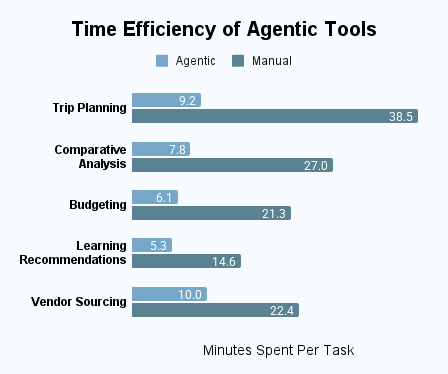
That is the upside SAP is reaching for in finance and the supply chain — though in mission-critical domains the harder constraint is accuracy, not speed.
Inside a Crowded Race Toward Autonomy
SAP isn't the only one painting this picture. As Constellation Research notes, ServiceNow, Salesforce, Microsoft, Workday, and the AWS hyperscalers are all chasing multi-agent workflows and natural-language interfaces for autonomous execution. SAP's vision is "not unique." Yet its grip on core enterprise data is a real advantage.
"It's the first time on this side of the millennium that SAP has a vision for ERP. And while the Autonomous Enterprise is not a unique vision, SAP has a compelling start to deliver it."
In other words, the verdict hinges not on novelty but on execution. Core systems can't go down. Whether SAP can advance autonomy while guaranteeing accuracy, compliance, and security is what will decide the contest.
Three Questions for Practitioners
Anyone weighing adoption should watch three things. First, how clean are your own business data and processes? If the "ground truth" you load into the Knowledge Graph is fuzzy, the agents' judgment will be too. Second, the sequencing of what you automate. Starting with high-routine, contained domains is safer than the unforgiving financial close. Third, whether you keep control over model choice. As SAP itself uses multiple models including Claude, a design not locked to one model is insurance for the future.
The more you hand to agents, the more human work shifts from operating to designing and supervising. What to delegate, where a person checks, and how errors get caught—drawing those lines is where managers earn their keep in the age of autonomy.
Key Takeaways
- At Sapphire in May 2026, SAP unveiled the "Autonomous Enterprise," anchored by the SAP Business AI Platform that unifies Business Technology Platform, Business Data Cloud, and Business AI.
- More than 50 Joule Assistants and 200+ specialized agents work in a two-tier design; finance alone splits into seven focus areas. Foundation models include Anthropic's Claude.
- Some agents arrive in Q2 2026 and Joule Work in H2 2026. SAP claims the financial close drops from "weeks to days" and ERP migration effort falls by more than 35% (as of May 2026).
- Rivals (ServiceNow, Salesforce, Microsoft, and others) are heading the same way; the real test is execution, not novelty. Adopters should weigh data readiness, automation sequencing, and freedom of model choice.
Sources
This article was independently written and edited by the Business Age Editorial Team based on the multiple verified sources below. See each source for full details.
- SAP News Center "SAP Unveils the Autonomous Enterprise"Read the original →
- Constellation Research (Holger Mueller)Read the original →
PR

Related
Related articles

ServiceNow Brings Its Autonomous Workforce to Every Department — AI That Acts, Not Just Advises

AI Agents Hit 72% Production — Yet Most Firms Still Can't Show the Value

Microsoft's Seven In-House MAI Models: A Lower-Cost Bid to Cut Its OpenAI Dependence

How "Delegating" Software Development Changed: Inside the Claude Code × Cursor Stack

The Day MCP Became AI's Universal Standard: What 10,000 Servers Mean for the Enterprise

Prompting in the GPT-5 Era: Why Over-Specifying Now Hurts Accuracy (2026)
Categories
Browse other categories





Get the latest business methods, first.
We share new articles and notable tools and trends on social.