
The Day MCP Became AI's Universal Standard: What 10,000 Servers Mean for the Enterprise
The Day MCP Became AI's Universal Standard: What 10,000 Servers Mean for the Enterprise
In December 2025, Anthropic donated MCP to the Linux Foundation and even OpenAI signed on. With 10,000+ servers and 97M monthly downloads in one year, here is what the shift from chatting AI to working AI means for business.
On December 9, 2025, the map of AI's "plumbing" was redrawn overnight. Anthropic donated the connection standard it invented, the Model Context Protocol (MCP), to the newly formed Agentic AI Foundation (AAIF) under the Linux Foundation. The co-founders were Anthropic, the payments company Block, and Anthropic's biggest rival, OpenAI. Three companies that usually trade blows chose to stand on the same foundation. In just one year, one firm's technology was promoted to shared industry infrastructure.
This is not a story for engineers alone. It marks the moment the ground firmed up beneath AI's shift from "talking smart" to "actually getting work done." Let us read what is happening on the ground, following the numbers and the facts.
Ten Thousand Servers in One Year: The Day MCP Became a Standard
MCP, released in November 2024, is an open standard for connecting AI applications to external systems. According to Anthropic's official announcement, in just one year the number of public MCP servers worldwide passed 10,000. Monthly SDK downloads exceeded 97 million across Python and TypeScript combined. Claude's connector directory now lists more than 75 destinations, and major AI products — ChatGPT, Cursor, Gemini, Microsoft Copilot, and Visual Studio Code — have all adopted it.
The AAIF was co-founded by Anthropic, Block, and OpenAI, with Google, Microsoft, AWS, Cloudflare, and Bloomberg in support. The goal is not for any single company to own the standard, but for the whole industry to cultivate a neutral foundation. That intent is captured plainly in the founding statement.
「to ensure agentic AI evolves transparently, collaboratively, and in the public interest」
Rather than fight over the standard, rivals chose to nurture it as a shared asset. The dynamics of today's AI industry are concentrated in that single decision.
Why It Is Called "the USB-C of AI"
Some background. Until now, connecting AI to external tools and data required writing dedicated integration code for each combination. With three kinds of AI and ten tools to connect, you would in principle build thirty separate "custom cables." Every new tool inflated development effort, and maintenance costs snowballed.
MCP introduced a "common port." Build one MCP-compatible server, and any compatible AI can call it the same way. That is why it is described as "the USB-C of AI." Just as settling on one cable shape freed both device makers and users from a drawer full of adapters, standardizing the way things connect freed AI integration from bespoke wiring.
This standardization of "how to connect" was the precondition for the agent era. For AI to wield external tools autonomously, the manner of connecting to those tools first had to be aligned.
From Conversation to Execution
It is worth noting how AI's role is changing in kind. The chat AI of old was a "consultant" that answered human questions. An agentic AI, by contrast, is an "operator": give it a goal and it plans the steps, calls external tools, checks results, and completes the task. It does not just draft an email — it sends it. It does not just read a table — it updates the database. MCP is the nervous system that supports that execution.
Anthropic's own "One year of MCP" graphic makes the abnormal speed of adoption clear at a glance.
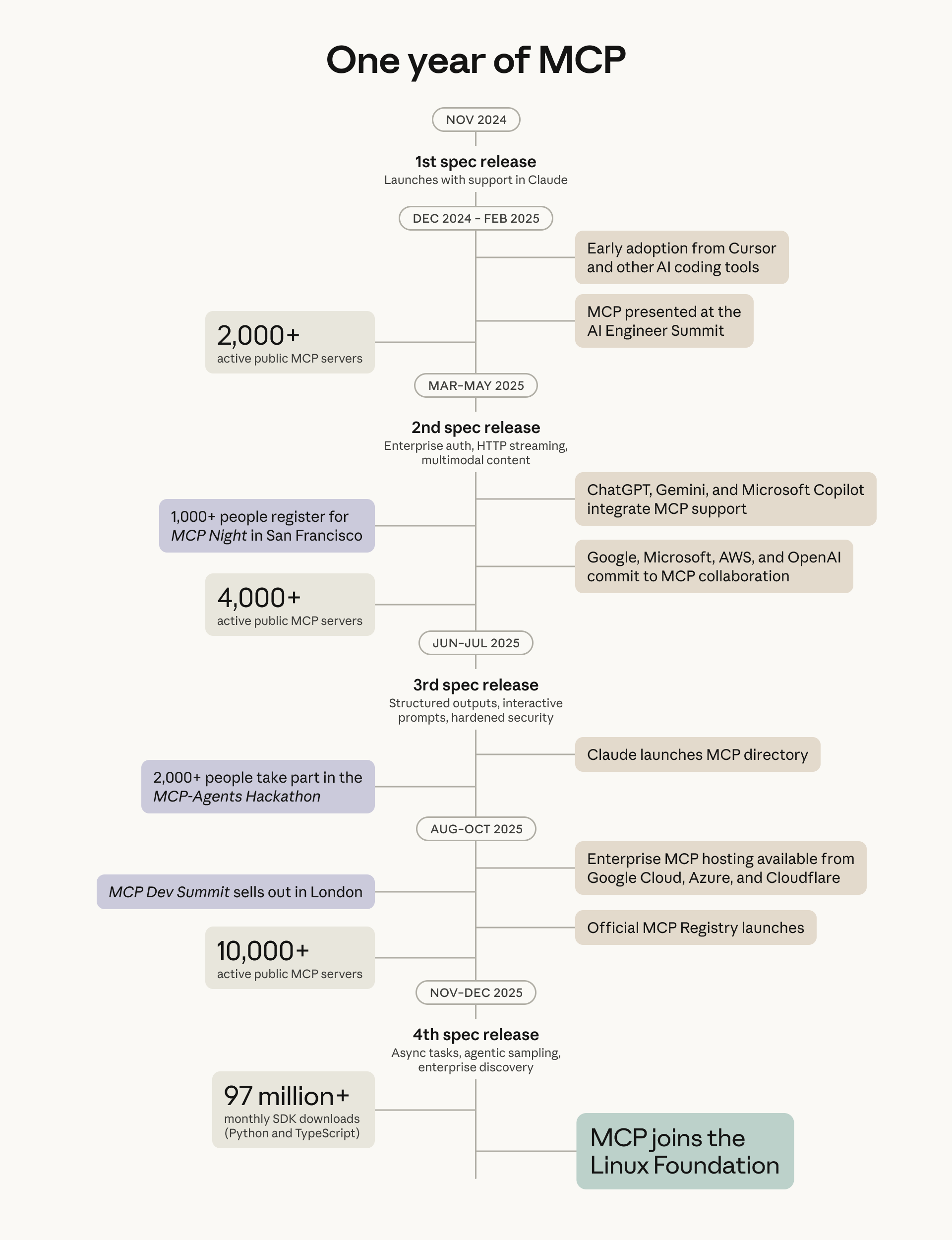
The chart traces public servers passing 2,000 in early 2025, 4,000 by summer, and 10,000 by autumn — a doubling every six months. Rival products like ChatGPT and Gemini declared support, and Google, Microsoft, and AWS began offering MCP hosting on their clouds. The process of the standard turning from "Anthropic's" into "everyone's" is etched directly into the adoption curve.
What the Numbers Say About Enterprise Adoption Today
So how far has the enterprise actually moved? Lining up the analysts' forecasts gives a sense of the temperature.
| Firm | Forecast | As of |
|---|---|---|
| Gartner | 40% of enterprise apps will embed task-specific AI agents (under 5% in 2025) | Forecast through end of 2026 |
| Gartner | Over 40% of agentic AI projects will be canceled | Forecast through end of 2027 |
| IDC | Enterprise AI agent usage will grow roughly 10x | Forecast through 2027 |
| McKinsey | Annual value created by AI agents | $2.6–4.4 trillion (estimate) |
As the table shows, Gartner expects 40% of enterprise apps to carry task-specific agents by the end of 2026. Given that the prior year sat under 5%, this is a literal step change. Yet the same Gartner warns that over 40% of agentic AI projects will be canceled by the end of 2027. The gap between expectation and reality is already surfacing in the numbers.
What Standardization Really Means for Executives
In practical terms, MCP's standardization means the risk of vendor lock-in has fallen. Tightly binding operations to one AI platform used to impose a heavy cost: rebuild the integration layer every time you switched. With a common standard, you can swap out the AI underneath while keeping your tool-connection assets intact. The premise of the investment decision changes.
Two perspectives are worth holding. The first is the design philosophy of "what you connect to" inside the company. Connecting agents to core data and business systems yields large gains — but it also means the AI holds write permissions. The second is the substance behind Gartner's "40% canceled." Most projects that stall trip not on technology but on vague objectives and weak governance. Only organizations that decide in advance what to delegate and what humans retain will reach for the fruit of standardization.
Why It Advances Anyway — and the Question Ahead
"40% canceled" also means 60% move forward. Now that the manner of connection is aligned and even rivals share the same foundation, the question has shifted from "whether to use agents" to "where to start." What MCP built is the entrance to a world where AI can freely open and close your company's toolbox.
What is tested is not technical skill but the design of delegation. What do you let AI execute, and who verifies the result, how? The more standardization advances, the more the difference comes down not to "the technology of connecting" but to "the judgment of delegating." The right next move is to pick one task in front of you and let an agent execute it on a small scale, with a human checkpoint in the loop.
Key takeaways
In December 2025, MCP was donated to the Agentic AI Foundation under the Linux Foundation, producing the unusual sight of rivals Anthropic and OpenAI backing the same standard. Adoption speed — over 10,000 servers and 97 million monthly downloads in a single year — is evidence that AI has shifted from conversation to execution. Gartner expects 40% of enterprise apps to embed agents by the end of 2026, even as it warns that over 40% of projects will stall. With standardization, the differentiator is not connection technology but the design of delegation: what to entrust and what humans keep. The common port is in place. What remains is to decide which of your own workflows to plug in first.
PR

Sources
This article was independently written and edited by the Business Age Editorial Team based on the multiple verified sources below. See each source for full details.
- Anthropic (official announcement)Read the original →
- TechCrunchRead the original →
- Linux Foundation (official press)Read the original →
- Joget (Gartner / IDC / McKinsey data)Read the original →
PR
Related
Related articles

SAP Bets on the "Autonomous Enterprise": When ERP Moves From Advice to Action

ServiceNow Brings Its Autonomous Workforce to Every Department — AI That Acts, Not Just Advises

AI Agents Hit 72% Production — Yet Most Firms Still Can't Show the Value

Microsoft's Seven In-House MAI Models: A Lower-Cost Bid to Cut Its OpenAI Dependence

How "Delegating" Software Development Changed: Inside the Claude Code × Cursor Stack

Prompting in the GPT-5 Era: Why Over-Specifying Now Hurts Accuracy (2026)
Categories
Browse other categories





Get the latest business methods, first.
We share new articles and notable tools and trends on social.