
From Ranking to Being Cited: How GEO Rewrites Marketing in the AI Search Era
From Ranking to Being Cited: How GEO Rewrites Marketing in the AI Search Era
As ChatGPT and AI Overviews answer queries directly, ranking first is no longer enough. What is GEO — the craft of being cited by AI? We read the primary data, the practical principles, and how it differs from SEO.
"Just ask ChatGPT — it'll give you the answer in one shot." This kind of remark is settling in as the option people reach for before they ever open a search engine. Users no longer have to scroll a list of blue links and assemble an answer themselves. AI summarizes, attaches a few sources, and hands over the conclusion. This shift poses a quiet but fundamental question to everyone who has ever drawn an audience on the web: is your content being cited inside the AI's answer?
This is where GEO — Generative Engine Optimization — comes in. If SEO is the craft of ranking high and getting clicked, GEO is the craft of being cited and mentioned inside an AI's answer. Drawing on primary research and practical principles, this article maps the new terrain of audience acquisition.
When "the Answer" Swallowed the Results Page
Start with the facts. Google's "AI Overviews," which inserts an AI summary at the very top of the results page, now appears across a wide range of queries. According to research by the marketing firm Writer.com, AI Overviews show up in 30–40% of search queries (as of 2026). Many searchers settle the matter with the AI summary before ever clicking a link. The "zero-click search" is becoming the norm.
Conversational AIs — ChatGPT, Perplexity, Claude — have themselves become enormous "front doors" to information. Ask a question and the AI reads the web, cites a handful of sources, and generates an answer. If you are not cited there, no ranking, however high, will put you in front of the user. The battlefield of visibility has moved from "rank" to "citation."
The Real Distance Between AI and Search, in Data
But beware the hype that "search is dead." Primary research by SparkToro — led by the veteran SEO figure Rand Fishkin, analyzing Datos (Semrush) clickstream — shows a calmer reality.
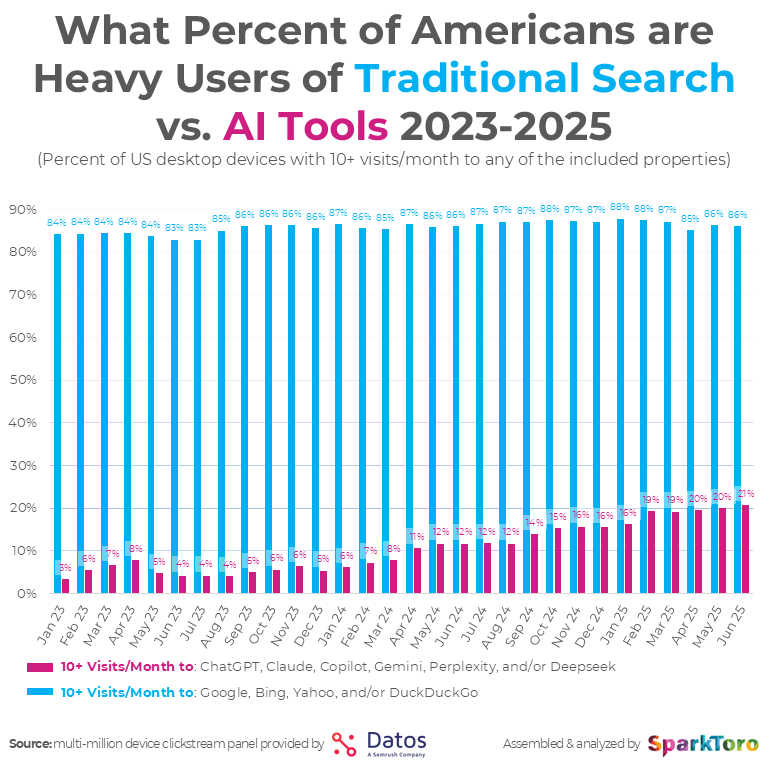
The chart tells two truths. First, heavy users of AI tools — those using them 10+ times a month — grew roughly sevenfold, from 3% in January 2023 to 21% in June 2025. Second, heavy users of traditional search held essentially flat, from 84% to 87%, not declining at all. AI did not "steal" search; it added a new front door next to it. Fishkin cuts through the narrative bluntly.
「The 'AI vs. Search' narrative is largely made-up by media and influencers seeking attention, rather than an accurate reflection of reality.」
In other words, GEO does not replace SEO. The right play is a two-front strategy: defend the existing door of search while extending visibility to the new door of AI.
What GEO Is — and How It Differs from SEO
So what concretely separates GEO from SEO? Here are the essentials.
| Dimension | Traditional SEO | GEO (Generative Engine Optimization) |
|---|---|---|
| Goal | Rank high and get clicked | Be cited/mentioned inside the AI answer |
| Unit of evaluation | Page-level ranking | Sentence/paragraph-level "citability" |
| What moves the needle | Backlinks, keyword coverage | Clear conclusions, primary data, stated expertise |
| How results appear | Over months | In RAG engines, shifts within 4–8 weeks |
The biggest difference lies in the unit of evaluation. Where SEO competes on the ranking of a whole page, GEO asks whether a single sentence is easy for AI to extract. AI tends to lift the paragraph that directly answers the question rather than reading the article whole. Writing that buries the conclusion under a long preamble is fatally disadvantaged in GEO.
How to Write So AI Cites You
To get onto the cited side, you must change the writing itself. The principles in Enrich Labs' practical guide come down to this. Answer the question head-on, and completely, within the first 200 words. Frame headers as the questions a reader would actually type. And carry your own primary data and original numbers rather than borrowed generalities — AI prefers to cite "facts" with source value.
Beyond that: make authorship and expertise explicit, earn third-party citations, structure for conversational queries, and keep content fresh. Much of this overlaps with classic SEO, but the emphasis differs. If SEO is "coverage and backlinks," GEO is "clarity and primary-ness." An article that answers one question sharply and owns the supporting numbers is far more citable than one that vaguely covers everything.
Making Your Site the One That Gets Cited
How should leaders and operators use this? First, recognize that GEO is an "additional layer" built on the SEO foundation. According to Enrich Labs, citations via AI tend to show measurable change in a relatively short 4–8 weeks. RAG-type engines — Perplexity, Google AI Overviews — read the live web, so structural fixes get a response within weeks. Compared with SEO's months-long campaign, you feel the improvement faster.
The perspective to hold is the question: are you a source of primary information? An article that merely re-summarizes someone else's study gives AI little reason to cite it. Operators who carry their own real data, field numbers, and original comparisons — the material AI judges as "a fact found only here" — keep their names inside the answers. Conversely, those without primary information grow structurally disadvantaged in AI-era acquisition. GEO is less a clever technique than a test of your business's substance: what can you say in your own words?
The Front Door Does Not Disappear — It Multiplies
Looking ahead, neither search nor AI vanishes; they coexist. As SparkToro's data shows, traditional search use has not declined. Meanwhile AI use has steadily accumulated and settled in as a new front door. The operator's question is not "SEO or GEO" but "how to be a cited presence at both doors."
What sets you apart is the courage to state the conclusion first and the strength of owning your own primary data. AI does not cite vague articles. Answer clearly, own your evidence — operators who can master that obvious discipline are the ones who keep their names inside the AI's answers.
Key takeaways
AI Overviews appear in 30–40% of queries (Writer.com research, as of 2026), and the battlefield of visibility has moved from "rank" to "citation." Yet the primary data is calm: SparkToro/Datos finds AI-tool heavy users surged from 3% (2023) to 21% (June 2025), while traditional search held flat at 84% to 87% — search is not declining. GEO does not replace SEO; it is an added layer on top. The keys are the clarity to answer the question within the first 200 words and owning primary data AI recognizes as "found only here." Whether you can get onto the cited side will decide audience acquisition in the AI era.
PR

Sources
This article was independently written and edited by the Business Age Editorial Team based on the multiple verified sources below. See each source for full details.
- SparkToro (Rand Fishkin / Datos primary research)Read the original →
- Enrich Labs, GEO Complete Guide 2026Read the original →
- SparkToro (Search vs AI, updated analysis)Read the original →
PR
Related
Related articles

How AI Search Rewired the Buying Journey — and Why Brands Now Compete to Be Cited

When AI Does the Shopping: Agentic Commerce and the Redesign of Marketing

The Age of AI That Buys for You: Visa and Mastercard Moved on the Same Day

Shopify Puts AI on Every Screen: Running a Store in the Agent Era

The Year AI Video Got Production-Ready: Veo and Where It Fits

How TikTok Shop Changes Selling: ~70% of Sales Come From Video and LIVE—Playbook for Discovery Commerce
Categories
Browse other categories





Get the latest business methods, first.
We share new articles and notable tools and trends on social.