
Selection and Overtime: What Japan's ¥761B Startup Funding Year Reveals
Selection and Overtime: What Japan's ¥761B Startup Funding Year Reveals
Japan's total startup funding in 2025 held roughly flat at ¥761.3 billion. Yet while the average round held steady, the median fell—capital shifted toward "selection and extended timelines." Drawing on Speeda/INITIAL and STARTUP DB data, we read what now separates the founders who get funded from those who don't.
While global venture investment set an all-time record in early 2026, startup fundraising in Japan wore an entirely different expression. Not flashy growth but "selection" and "overtime"—a quiet structural shift in which investors began scrutinizing the essence of each business more cautiously and more strictly.
According to Japan Startup Finance 2025, compiled by Speeda (formerly Uzabase) and INITIAL, total domestic startup funding in 2025 (excluding debt) was ¥761.3 billion, roughly flat versus the prior year. By the headline total alone, it looks like a year where nothing changed. But dig one layer deeper and you can see that the very way money flows has transformed.
In this piece, we cross-reference the full-year data with the latest January 2026 funding ranking to lay out—from both founder and investor perspectives—what now separates "the founders who get chosen" from "the founders to whom capital does not reach" in Japan.
The Total Held Flat, but the Median Tells the Real Story
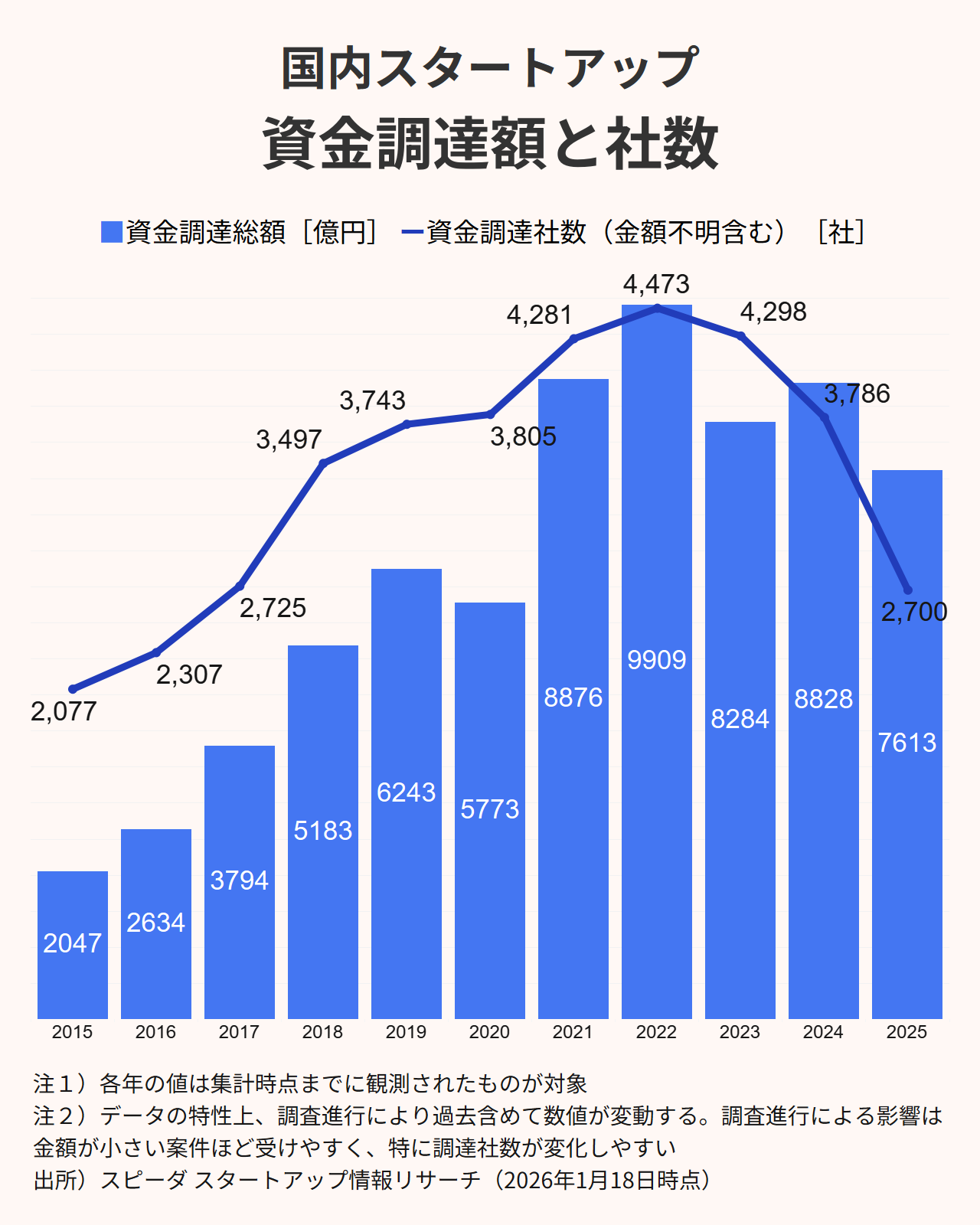
The most telling figure is the divergence between average and median. By Speeda/INITIAL's count, the average round size in 2025 was ¥310 million, unchanged from the prior year. Yet the median fell from ¥77.6 million the year before to ¥62.4 million. When the average holds while the median drops, it means a handful of large rounds are lifting the overall average, even as the great majority of companies can raise only smaller sums.
In other words, Japan too is bifurcating, just as the global market is. What differs is scale. Globally, multi-billion-dollar megadeals lifted the average; in Japan, rounds in the tens-of-billions-of-yen range play the same role. For companies at the base, the bar to raise has crept up, and "stitching together smaller amounts" has spread in place of raising big in one shot.
"selection and extended timelines" (選別と延長戦)
The phrase "overtime" is emblematic. Fundraising periods have lengthened, and more companies are choosing not to disclose amounts. Carefully gauging the distance to the next round, extending the cash on hand, and taking time to prove out the business—such management judgment is becoming the norm.
Why Investors Turned So Cautious
Behind this lies a structural change in fund formation. Per the same report, fund formation in 2025 exceeded the prior year in both count and total. Capital itself did not dry up. That investment nonetheless turned selective is because the standard fund size shrank while a few very large funds propped up the overall total. When mid-sized and smaller funds turn cautious, the money reaching early- and mid-stage startups is naturally squeezed.
Changes in the exit environment are also tightening investment decisions. The report notes a "shift toward higher-quality IPOs" following revisions to listing-maintenance standards. Rather than just getting listed, the question became whether a company can keep growing after listing. M&A held at a high deal count, and the diversification of exit strategy away from an IPO-only path is another feature of recent years.
When investors turn this cautious, the question put to founders becomes simple: "On what, how much, and how durably does your business earn?" Merely raising the banner of AI or deeptech no longer moves money. In fact, capital is concentrating in domains that can show a clear technical edge or a path to profitability.
What January 2026's Ranking Shows About Where Money Goes
That tendency appears clearly in the new-year funding ranking. The top of STARTUP DB's January 2026 ranking of domestic startup rounds was occupied entirely by capital-intensive deeptech and core-industry companies.
| Rank | Company | Raised | Round / Field |
|---|---|---|---|
| 1 | Akari | ~¥5.0B | AI-driven DX for construction & manufacturing (Univ. of Tokyo spinoff) |
| 2 | Interstellar Technologies | ~¥4.72B | Series F; small-satellite launch rocket "ZERO" |
| 3 | enechain | ~¥2.47B | Series B add-on; wholesale electricity marketplace |
- Figures per STARTUP DB, based on the January 2026 domestic funding ranking. Interstellar's Series F totaled ~¥20.1B and enechain's Series B ~¥5.05B as announced.
Top-ranked Akari is a University of Tokyo spinoff that has driven DX in construction, manufacturing, and logistics profitably. Second-place Interstellar Technologies is a leading space venture pursuing vertical integration of small rockets and communications satellites; third-place enechain operates a wholesale electricity trading marketplace. AI, space, and energy—all are domains with high barriers to entry where accumulated technology translates directly into competitiveness.
Here is the outline of where Japan's money flows. Rather than general-purpose apps or services, limited capital concentrates in businesses with clear specialization, technical advantage, and necessity as social infrastructure. This overlaps with the government's priority investment areas, and policy support further channels the flow of money.
How Founders and Investors Should Live in This Environment
How should founders take this phase? First, recognize the trap that "fundraising easily becomes an end in itself." With the median down and overtime the norm, what sways evaluation is not raising a large sum at once but how far you can advance proof of the business with limited capital. Can you hold down your burn rate and build "progress you can describe in numbers" before the next round? Investors are watching not the amount raised but what was proven with it.
For investors, it becomes a year that tests the precision of selection. In an environment where the total is flat and money skews to large deals, conviction-led concentration in a few promising domains outperforms diversified bets aiming for average returns. At the same time, more overtime means heavier decisions on bridge funding for existing portfolios. That exits are diversifying toward M&A, not IPO alone, is also a chance to draw recovery scenarios along multiple tracks.
For corporates and would-be founders, this environment is by no means all gloom. The more selective capital becomes, the more businesses with essential value stand out by comparison. If you can hold even one clear strength—AI, deeptech, or global reach—this is arguably an era in which you are more likely to be valued.
The 2026 Question Beyond the Flat Line
If 2025 was "structural change within a flat total," the focus of 2026 is whether this selective trend reverses or sets in. Globally, record capital is pouring into AI, and that heat may spill over to Japan's promising startups. On the other hand, if domestic investors keep their cautious stance, bifurcation will advance further.
The keys are exit track record and policy execution. If high-quality IPOs and M&A continue, investors can confidently commit the next round of capital. If support for the government's priority areas ties to concrete results, money will flow further in that direction. Behind the quiet of a flat number, Japan's startup market is steadily, if silently, sharpening the precision of the question: to whom should we entrust capital?
Key Takeaways
Japan's total startup funding in 2025 was ¥761.3 billion (excluding debt), roughly flat year-over-year. Yet while the average round held at ¥310 million, the median fell from ¥77.6 million to ¥62.4 million—capital shifted toward "selection and extended timelines." Fund totals grew but the standard size shrank, with very large funds propping up the whole. Exits shifted toward higher-quality IPOs while M&A stayed high. January 2026's top rounds concentrated in deeptech—Akari (construction/manufacturing AI), Interstellar (space), enechain (energy). Founders are asked what they proved with capital, not how much they raised; investors, for conviction over diversification.
PR

Sources
This article was independently written and edited by the Business Age Editorial Team based on the multiple verified sources below. See each source for full details.
- Speeda/INITIAL — Japan Startup Finance 2025Read the original →
- Speeda press release (PR TIMES) — Japan Startup Finance 2025Read the original →
- STARTUP DB — Japan startup funding ranking (Jan 2026)Read the original →
PR
Related
Related articles

June 2026's AI Money Goes to "Applied AI": Reading the Investment Terrain Founders Should Watch

AI Funding Hits $300B in a Quarter — Reading the Terrain Beneath the Mega-Rounds

How AI Minted the World's Youngest Self-Made Billionaires: Forbes' Under-30 List 2026

$2.59 Trillion in AI Spending: What Gartner's "Inflection Year" Really Means

Big Money Floods AI Customer Support — So Why Are Some Firms Rehiring Humans?

From Broad-and-Shallow to Narrow-and-Deep: Why Money Flows to Vertical AI Agents
Categories
Browse other categories





Get the latest business methods, first.
We share new articles and notable tools and trends on social.