
Big Money Floods AI Customer Support — So Why Are Some Firms Rehiring Humans?
Big Money Floods AI Customer Support — So Why Are Some Firms Rehiring Humans?
Capital is pouring into AI customer-support startups, with Sierra valued above $15B. Yet Klarna brought human agents back. From the rise of outcome-based pricing to the limits of "AI-first," we examine the takeaways for investors and operators.
How much of a human's job can an AI agent take over? The fastest, most concrete answers to that question are emerging in customer support. Heading into 2026, an astonishing amount of capital has flowed into startups in this space. At the same time, a company that moved early to "AI-first" has begun bringing human agents back — a notable correction. You cannot measure this technology's real value without looking at both the investor euphoria and the reality on the ground.
What sky-high valuations signal
The emblem of this space is Sierra. Co-founded in March 2023 by Bret Taylor — former co-CEO of Salesforce and former CTO of Facebook — the company raised $950 million in May 2026 in a round led by Tiger Global and GV, pushing its valuation above $15 billion (per Built In SF, as of May 2026). It counts 40% of the Fortune 50 as customers.
The other heavyweight, Decagon, reached a $4.5 billion valuation in January 2026, on a $250 million Series D led by Coatue and Index Ventures (per Sacra). Its annualized revenue grew from $10 million at the end of 2024 to $35 million by October 2025 — more than tripling in under a year. It was only founded in August 2023.
| Company | Valuation | Founded | Notable traction |
|---|---|---|---|
| Sierra | Over $15B (May 2026) | March 2023 | 40% of the Fortune 50 |
| Decagon | $4.5B (Jan 2026) | August 2023 | $35M annualized revenue (Oct 2025) |
*Valuations and founding dates per Built In SF reporting and Sacra (as of each date noted).
Neither company is yet three years old. That such valuations attach anyway reflects investors' growing conviction that AI agents have moved past "experiment" and into "revenue-generating product" embedded in companies' core operations.
Why outcome-based pricing pulls in investors
Both companies share an approach to billing. Sierra champions outcome-based pricing — charging only when an inquiry is correctly resolved — and Decagon offers a model that bills per resolution. Rather than a flat monthly fee, you pay for the work the AI actually completes.
This pricing is itself a statement of confidence. If resolution rates are low, revenue does not materialize, so you cannot adopt this model without believing your AI truly does the job. For the buying company, it lowers the barrier to adoption: if there is no effect, there is nothing to pay. Investors are bullish here because outcome-linked revenue is more resilient to economic swings than traditional software and is tied directly to the customer's business results.
The flip side is that a single metric — resolution rate — becomes the lifeline of the business. How autonomously the AI can dispatch problems translates directly into revenue.
The measurable gains, and their ceiling
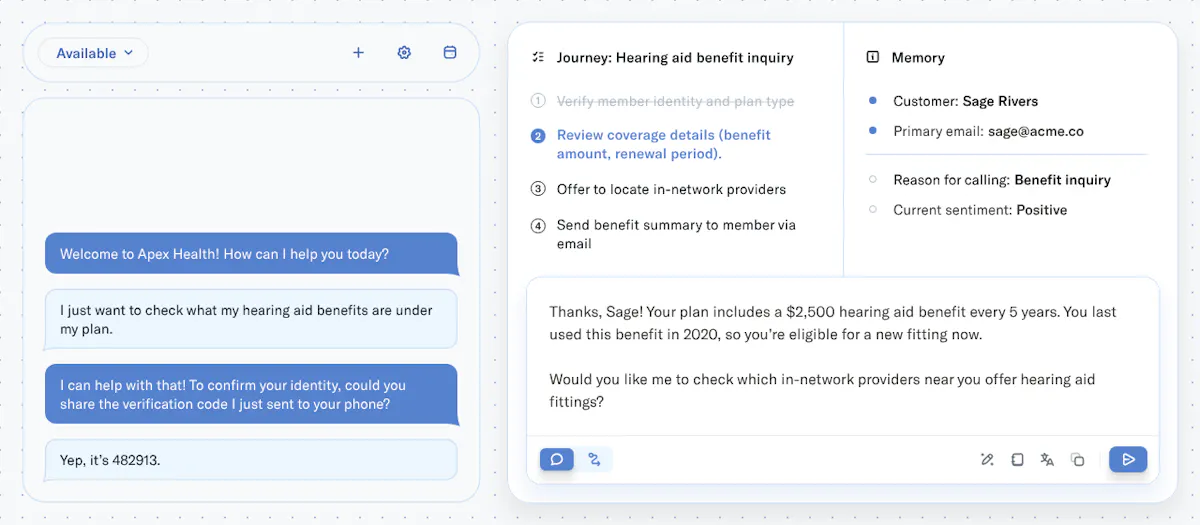
The real-world effect is too large to dismiss. At the buy-now-pay-later giant Klarna, the AI assistant had come to do the work of 853 full-time employees as of the third quarter of 2025 (up from the equivalent of 700 at the start of the year). It handled roughly 1.3 million conversations a month, with an average resolution time of about two minutes, customer satisfaction on par with human agents, and a company-wide NPS reaching 73. Cost per transaction for support fell about 40%, from $0.32 in the first quarter of 2023 to $0.19 in the first quarter of 2025.
On Decagon's side, one customer reportedly cut its support headcount by 80% and reached a 90% resolution rate without human intervention. Ramp, a Sierra customer, is said to handle about 90% of support cases autonomously. By the numbers alone, AI is now at the stage where it can dispatch the bulk of routine inquiries.
But it would be premature to stop here and conclude that humans become unnecessary. These high resolution rates apply to routine inquiries with clear rules. For cases where judgment is split, emotionally charged complaints, or unprecedented requests, the story is not as simple as the numbers suggest.
The wall that "AI-first" hit
The company that most candidly acknowledged that limit was, of all firms, Klarna. In May 2025 it conceded that cost-driven automation had lowered the quality of the customer experience, and it pivoted toward rehiring human agents.
"You will always [have] a human if you want."
This shift does not negate the value of AI support. Klarna still handles the majority of conversations with AI. The point is the realization that "leave everything to AI" and "make AI the workhorse while humans handle the crucial moments" are two different things. Cut people purely to reduce costs, and you drop customers in hard moments, ultimately losing the most expensive thing of all — trust. The optimum was not replacement but a division of labor between AI and humans.
What investors and operators should read into it
How should you view this space? From an investment standpoint, look less at the headline valuations and more at the quality of revenue that outcome-based pricing represents. Revenue tied to the customer's business results is more durable than mere usage fees. At the same time, a plateau in resolution rates, and "corrections" like Klarna's happening at other firms, are risks to price in alongside the optimism.
The implication for companies considering adoption is equally clear. AI support should be seen not as "a tool for headcount cuts" but as "a foundation that raises overall capacity and redirects humans to harder work." Let AI handle routine cases while people concentrate on exceptions and on building trust with customers. Success in adoption hinges less on the AI's raw performance than on how carefully you design that division of labor.
Key takeaways
In 2026, huge sums gathered around AI customer-support startups: Sierra reached a valuation above $15B (May 2026) and Decagon $4.5B (January 2026). Their outcome-based pricing models reflect confidence that the AI actually completes the work, and that is part of what draws investors. As Klarna's case shows, AI can do the work of hundreds of employees, yet cost-only full automation hits a quality wall. The company bringing humans back was not a defeat but an arrival at the realistic answer: a division of labor between AI and people. In both investing and operations, designing for division — not replacement — is the key to maximizing this technology's value.
PR

Sources
This article was independently written and edited by the Business Age Editorial Team based on the multiple verified sources below. See each source for full details.
- Built In SF — Sierra Raises $950M at $15B ValuationRead the original →
- Contrary Research — Sierra Business BreakdownRead the original →
- Sacra — Decagon revenue, valuation & fundingRead the original →
- CX Dive — Klarna AI agent does work of 853 employeesRead the original →
PR
Related
Related articles

June 2026's AI Money Goes to "Applied AI": Reading the Investment Terrain Founders Should Watch

AI Funding Hits $300B in a Quarter — Reading the Terrain Beneath the Mega-Rounds

How AI Minted the World's Youngest Self-Made Billionaires: Forbes' Under-30 List 2026

$2.59 Trillion in AI Spending: What Gartner's "Inflection Year" Really Means

From Broad-and-Shallow to Narrow-and-Deep: Why Money Flows to Vertical AI Agents

$14.6B in Five Months: The VC Money Pouring Into Defense Tech in 2026
Categories
Browse other categories





Get the latest business methods, first.
We share new articles and notable tools and trends on social.