
Cursor at $60 Billion: What Vibe Coding Actually Changed
Cursor at $60 Billion: What Vibe Coding Actually Changed
SpaceX is acquiring Cursor's parent Anysphere for about $60 billion. We unpack the freakish zero-to-$2B-ARR growth, the split between pro editors and prompt-to-app tools, and how far you can really lean on AI in your own engineering shop.
On June 16, 2026, SpaceX announced it would acquire Anysphere—the company behind the AI coding tool Cursor—for roughly $60 billion in an all-stock deal. A rocket-and-satellite company put that price, in its own shares, on a code-completion tool that runs inside an engineer's editor. The move captures how "vibe coding"—instructing an AI in plain language to produce working code—has stopped being an experimental buzzword and started being treated as business infrastructure that shapes competitiveness. This piece lays out the deal, Cursor's unusual growth curve, and the split between "pro" and "non-engineer" tools, then asks, from a practitioner's seat, how far you can actually lean on these tools in your own shop.
What a $60 billion acquisition signals
According to reporting, SpaceX disclosed the agreement to acquire Anysphere on June 16, 2026. The consideration is roughly $60 billion, paid entirely in SpaceX stock rather than cash. The announcement landed just after SpaceX completed its own blockbuster listing on June 12, letting it spend freshly minted public shares as a currency to reinforce its AI position. Per multiple outlets (TechCrunch, CNBC, Reuters), the deal is expected to close in the third quarter of 2026, pending regulatory approval.
The groundwork was laid that April. SpaceX is said to have secured an option with Anysphere to choose between a partnership worth about $10 billion or a later acquisition at $60 billion. It chose the more expensive path. The rationale: to bolster the AI business of xAI—reportedly folded into SpaceX in February 2026—through coding assistance, the area where AI has most clearly turned into enterprise revenue.
Why would a rocket company pay this much? A clue lies in its IPO pitch. SpaceX reportedly told investors during its roadshow that the AI opportunity was enormous.
"A $26 trillion addressable market in AI"
Whatever the merits of that figure, when you are chasing a market that large, a coding AI already pulling real money out of corporate budgets looks like the shortest path in.
Zero to $2B ARR in two years—an outlier
Cursor was founded in 2022 by four MIT-trained founders (including Michael Truell). Built on top of the familiar VS Code editor, it won users by ingesting an entire codebase and letting an AI agent handle edits that span multiple files.
The growth is abnormal. Annual recurring revenue (ARR) climbed from about $100 million in January 2025 to over $500 million that June, roughly $1 billion in November, and about $2 billion by February 2026. Reuters put annualized revenue at around $2.6 billion at the time of the deal. Valuation kept pace.
| As of | Valuation | Event |
|---|---|---|
| Aug 2024 | ~$0.4B | Early round |
| Jun 2025 | ~$9.9B | ARR over $500M; led by Thrive Capital |
| Nov 2025 | ~$29.3B | Series D, $2.3B (led by Accel/Coatue) |
| Jun 2026 | ~$60B | SpaceX acquisition agreement |
Paying users top one million, some 50,000 businesses use it, roughly half the Fortune 500 were on it as of June 2025, and enterprise accounts make up about 60% of revenue (Contrary Research, The Next Web). Individual pricing tiers run from a free Hobby plan to Pro ($20/mo), Pro+ ($60/mo), and Ultra ($200/mo), as of December 2025.
The split: "pro editor" vs. "prompt-to-app"
Vibe coding gets lumped together, but it is actually growing in two distinct directions.
One is the augmented editor for professional engineers, epitomized by Cursor. It reads your existing codebase and delegates review, refactoring, and testing to an AI agent. GitHub Copilot, with more than 20 million all-time users as of July 2025, is the incumbent—yet Contrary Research reports that about 95% of teams who evaluated the two side by side chose Cursor. Against Copilot's autocomplete-centric approach, Cursor pulled ahead on codebase comprehension and agent autonomy.
The other direction draws in non-engineers: the "prompt-to-app" model. Lovable, the standout, turns plain-language instructions into a UI-equipped web app and even handles deployment. In December 2025 it raised $330 million led by Menlo Ventures and CapitalG at a $6.6 billion valuation (TechCrunch). By late 2025 it was nearing 8 million users, with more than 100,000 new projects created per day. The audience that once relied on no-code tools like Webflow or Bubble is flowing here.
In other words, even within "let the AI write it," a tool that lifts the productivity of people who can read code and a tool that gives an exit to people who cannot are aimed at different markets and judged on different terms. Lumping them together as "AI coding" makes adoption decisions easy to get wrong.
How it actually plays out on the ground
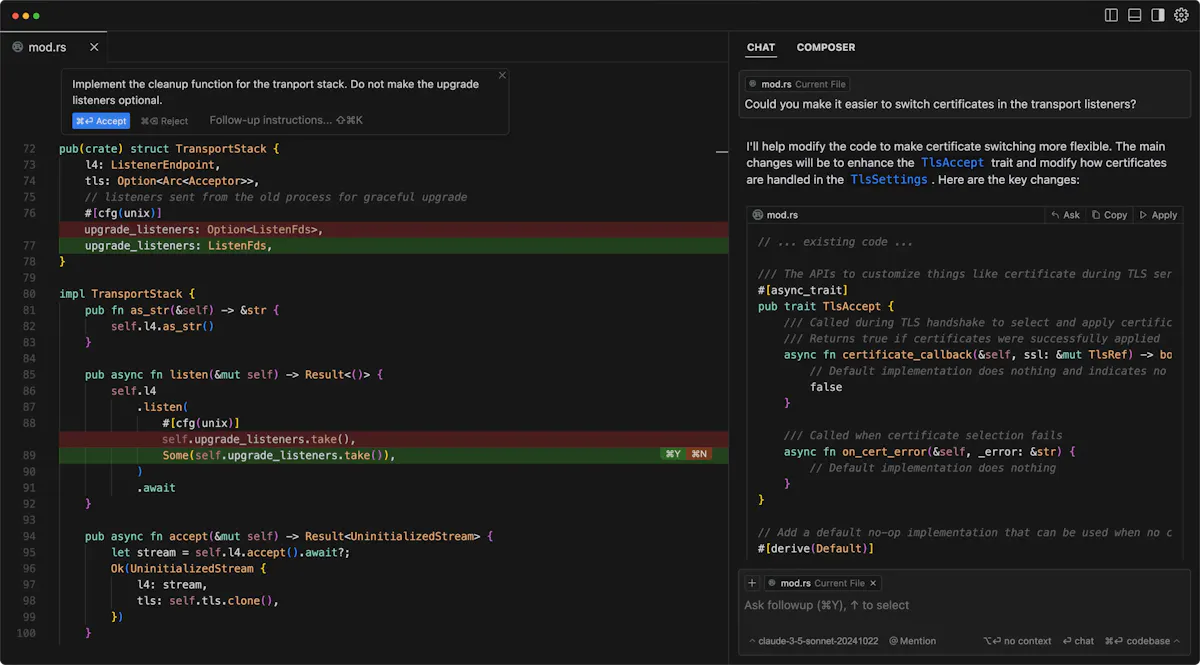
Now the buyer's view. Bluntly, these tools pay off most for teams that already carry a working codebase. The agent model shines less on one-off greenfield apps than on modifying existing assets, writing tests, and grinding through boilerplate. Teams that have the AI draft and a human judge—where that division of labor genuinely runs—do feel faster.
The dangerous pattern is shipping generated output straight to production without reading it. The easier it is to get something that "works" from a prompt, the harder it is to see that working, maintainable, and safe are three different things. Expect more incidents where an internal app built with a non-engineer tool spreads without proper access control or handling of personal data.
The decision axes are simple. First, can you institutionalize a step where a human always reviews the output? Second, can you draw a clear line around how much confidential code goes to an external model (this is exactly what companies pay for in enterprise contracts and permission controls)? Third, can you shift your metric from "lines written" to "code that passed review and didn't break in production"? Outcomes hinge not on the tool's speed but on how the organization absorbs it.
What changes after the acquisition
How much independence Cursor keeps under SpaceX is still unclear. Enterprise users wary of becoming a strategic product for one giant backer may diversify toward neutral alternatives (Copilot, other editors, open options). On the other hand, deep capital plus xAI's models could let it pull even further ahead on features.
What is certain is that coding AI has moved from "nice to have" to "a condition of competition." Rather than chasing which tool is marginally better, it pays far more to decide which steps of your pipeline you embed generative AI into, and with what guardrails. In your own shop—who approves AI-written code, and by what standard?
Key takeaways
- On June 16, 2026, SpaceX announced it would acquire Cursor's parent Anysphere for about $60 billion (all-stock); the deal is expected to close in Q3 2026 (TechCrunch, CNBC, Reuters).
- Cursor's ARR rose from about $100M in January 2025 to roughly $2B by February 2026, with annualized revenue near $2.6B at announcement (Reuters); valuation climbed from about $0.4B in August 2024 to $60B.
- Vibe coding has split into pro editors (Cursor) and non-engineer prompt-to-app tools (Lovable, valued at $6.6B).
- Success depends not on tool speed but on the organization's design: a review step, a confidentiality boundary, and a shift in success metrics.
PR

Sources
This article was independently written and edited by the Business Age Editorial Team based on the multiple verified sources below. See each source for full details.
- TechCrunch: SpaceX to acquire Cursor for $60BRead the original →
- The Next Web: Cursor $50B valuation talksRead the original →
- Contrary Research: Cursor business breakdownRead the original →
- TechCrunch: Lovable raises $330M at $6.6BRead the original →
PR
Related
Related articles

SAP Bets on the "Autonomous Enterprise": When ERP Moves From Advice to Action

ServiceNow Brings Its Autonomous Workforce to Every Department — AI That Acts, Not Just Advises

AI Agents Hit 72% Production — Yet Most Firms Still Can't Show the Value

Microsoft's Seven In-House MAI Models: A Lower-Cost Bid to Cut Its OpenAI Dependence

How "Delegating" Software Development Changed: Inside the Claude Code × Cursor Stack

The Day MCP Became AI's Universal Standard: What 10,000 Servers Mean for the Enterprise
Categories
Browse other categories





Get the latest business methods, first.
We share new articles and notable tools and trends on social.