87% of Japanese Firms Use Generative AI—Yet They Rank Last at Turning It Into Profit
87% of Japanese Firms Use Generative AI—Yet They Rank Last at Turning It Into Profit
PwC's six-country survey (February 2026) shows generative AI adoption among Japanese firms has climbed to 87%. But only 40% have turned that investment into financial results—the lowest of the six. Why does Japan, now level on adoption, stumble at the "value creation" and "value capture" walls?
The conversation around generative AI has clearly shifted gears over the past year. The question is no longer "should we adopt it," but "is the money we spent coming back as profit." PwC Consulting's "Generative AI Survey 2026 Spring," conducted February 12–19, 2026 across six countries—Japan, the US, the UK, China, Germany and South Korea—puts that turning point into hard numbers. The Japanese sample comprises 932 respondents at manager level or above at companies with revenue above ¥50 billion.
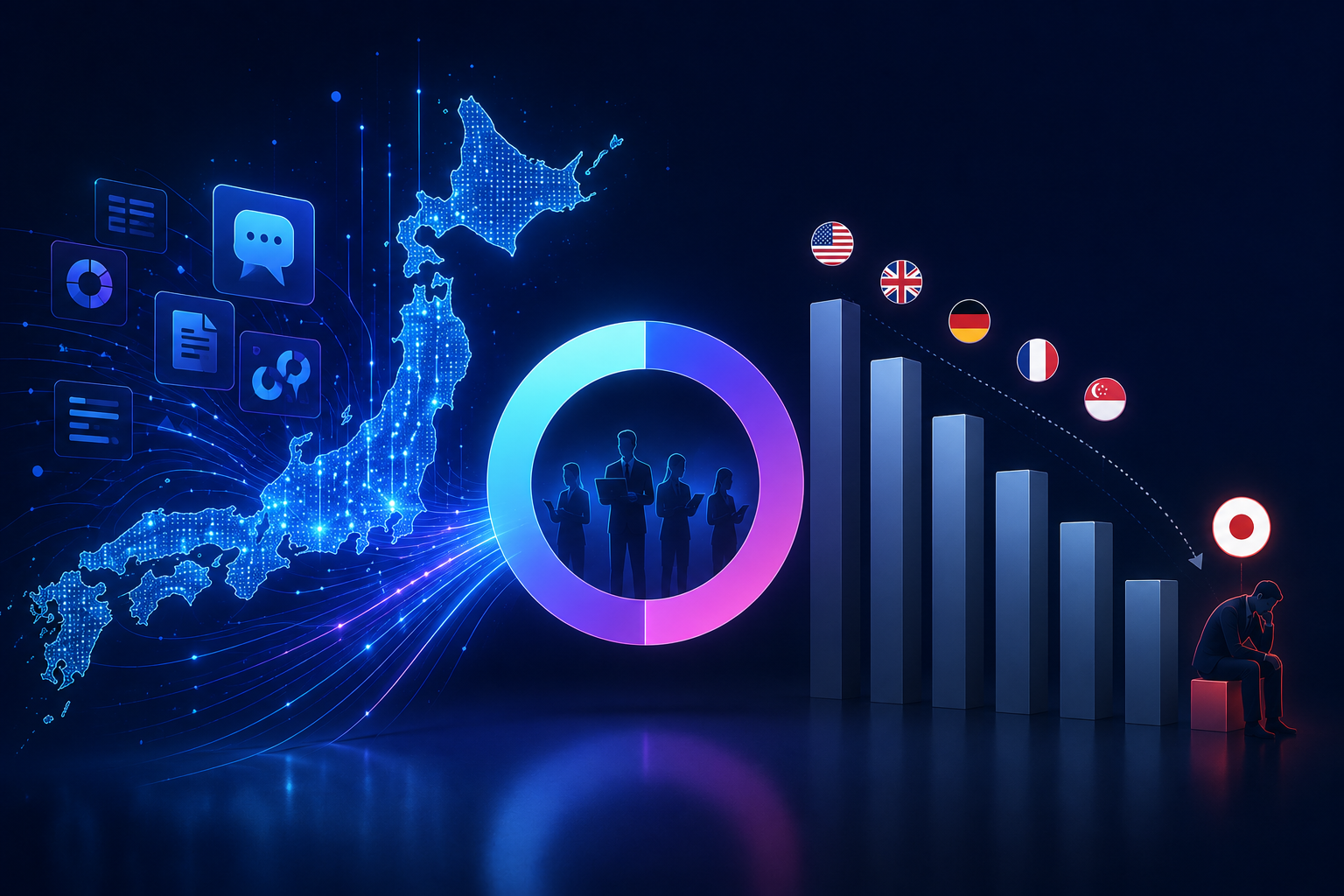
According to the survey, 87% of Japanese firms are now using or actively rolling out generative AI—up 11 points from the previous round. It is no longer "something only a handful of frontrunners do." Yet only 40% have managed to convert that investment into financial results—dead last among the six countries. Set against the US (75%) and the UK (74%), the gap is hard to ignore.
"We've got it working. But it isn't feeding the bottom line yet." That uncomfortable plateau is where many Japanese companies now stand. Below, we trace the survey's numbers to see where firms are getting stuck—and what the companies that broke through actually changed.
The "should we adopt it" era is over
Japan's 87% adoption-and-rollout figure (as of February 2026) also means that the share of firms still on the sidelines—not started, or abandoned—has fallen to just 4%. A few years ago generative AI was something IT departments and a few advanced users experimented with; now it is being built into operations at company-wide scale.
What stands out is that Japan's 87% is the lowest of the six. South Korea sits at 93%, China 91%, the US 90%, and the UK and Germany both at 89%. The old narrative that "Japan is slow to adopt" no longer holds—at least on the entry metric of adoption rate, the gap between countries has narrowed to a few points. Lagging adoption is no longer Japan's essential problem.
Dead last on "felt impact"
The real divergence comes next. While 38% of US firms and 32% of UK firms said generative AI was delivering "results far beyond expectations," in Japan the figure was just 9%. And while 66% of US firms expect impact within a year of starting an initiative, only 41% of Japanese firms do (all figures as of February 2026).
| Metric (as of Feb 2026) | Japan | US | UK |
|---|---|---|---|
| Using / rolling out generative AI | 87% | 90% | 89% |
| Results far beyond expectations | 9% | 38% | 32% |
| Expect impact within one year | 41% | 66% | — |
| Converted investment into financial results | 40% | 75% | 74% |
What the table reveals is a clear pattern: at the entry point (adoption) the countries are roughly level, but at the exit (felt impact and financial return) Japan alone is left far behind. Adoption is done. It is the next stage—turning use into results—where Japan is treading water.
The two walls Japanese firms hit
PwC frames the situation this way.
"The wall from use to value creation, and the wall from value creation to value capture."
The first wall is the state where teams are using the tools but no clear operational gain—time saved, quality improved, revenue contributed—has emerged. The second wall is where, even when there is a gain on the ground, firms fail to translate it into financial figures such as reworked staffing or cost structures. In Japan, 19% of firms report capturing no financial return at all—the highest of the six countries, and the single biggest bottleneck.
Tellingly, the more a company feels real impact, the further it carries that gain through to its employees. Among firms seeing results far beyond expectations, 71% pass profit back to staff, versus just 14% among firms whose results fell short. Value creation and value capture are not separate problems—they are one connected flow.
What the winners had in common
So what set the breakthrough companies apart? The survey points to three traits shared by firms that exceeded expectations: placing the AI program close to top management, embedding AI agents (AI that executes tasks autonomously rather than waiting for instructions) into operations, and using multiple models rather than depending on a single one.
The flip side is that many firms with no results have left generative AI to the front line and the tools. They stopped at "we handed out a handy chat tool" and never went so far as to redesign the work process itself. Getting results from generative AI is not about distributing a new tool—it is about rebuilding the flow of work around that tool. The survey drives that obvious point home once again.
The shift in mindset is also worth noting. The share of firms that see generative AI as "a chance to fundamentally transform our industry structure" rebounded to 30%, while those viewing it as "a threat that could erase our reason for being in business" rose to 24% (as of February 2026). Rising hope and rising anxiety at the same time is a sign that generative AI is shifting from a "nice-to-have tool" to a "precondition for competing."
What comes next is designing the payback
The next move for Japanese firms is clear. It is not to add more tools, but to design the "payback" that turns tools already deployed into results. How much is spent on which task, how many hours or yen of impact is expected, by when, and under which accounting line does it get recouped? Only the firms that can answer that will clear the two walls.
Having caught up with peers on adoption rate, what Japan must catch up on next is the operational discipline to measure impact and book it to the financials. Skill with generative AI is no longer decided by model performance or prompt craft, but by whether an organization can build the machinery to capture results.
Key takeaways
- In PwC's six-country survey (as of February 2026), generative AI adoption among Japanese firms rose to 87%. On adoption rate they are within a few points of South Korea (93%) and the US (90%)—the entry-point lag has essentially closed.
- Yet "results far beyond expectations" reached only 9% in Japan (US 38%, UK 32%), and financial return on investment was 40% (US 75%, UK 74%)—both last of the six. Adoption has advanced, but it isn't being converted into results.
- The stumbling points are two walls: "use → value creation" and "value creation → value capture." With 19% capturing no financial return (the highest of the six), the latter weighs especially heavily on Japan.
- Firms that delivered results shared three traits: a program close to top management, deployed AI agents, and the use of multiple models. The key is not handing out tools but redesigning the work process—and explicitly designing the payback.
PR

Sources
This article was independently written and edited by the Business Age Editorial Team based on the multiple verified sources below. See each source for full details.
- PwC Consulting, "Generative AI Survey 2026 Spring"Read the original →
- Mynavi News, "87% of Japanese firms use generative AI, last of six on financial return"Read the original →
- ASCII.jp, "Japanese firms stalling on value creation: PwC six-country comparison"Read the original →
PR
Related
Related articles

Microsoft's $10 Billion Bet on Japan as an AI Infrastructure Hub

SoftBank Group's Record ¥5 Trillion Profit—and Why Most of It Is an Unrealized Gain

AI Spending Has Changed Orders of Magnitude: $725B Across Four Firms, $500B for Stargate

Data Center Revenue Up 92%: What NVIDIA's Earnings Reveal About AI Infrastructure

OpenAI's $38.5B Loss and Triple-Digit Growth: Reading the Bet Behind "Invest-First" AI

The Real Map of AI Side-Income: The Skills That Doubled, and Why Humans Still Win
Categories
Browse other categories





Get the latest business methods, first.
We share new articles and notable tools and trends on social.