
One in Three Startups Now Flies Solo: The Real Economics of the AI One-Person Company
One in Three Startups Now Flies Solo: The Real Economics of the AI One-Person Company
More than one in three new startups is now solo-founded. AI handles most of the execution, and a few founders run multimillion-dollar businesses with zero employees. Using the latest Carta and Fortune data, we map how far the one-person company has come — and the cost of leaving it all to the machine.
Building a company once meant finding a co-founder, leasing an office, and hiring a team. That assumption is quietly collapsing. According to Carta, more than one in three new U.S. startups in the first half of 2025 was solo-founded. As AI takes over most of the day-to-day execution, founders are now running multimillion-dollar businesses with zero employees. Yet the cost of leaving everything to the machine is becoming just as visible. Let us read the present state of solo entrepreneurship through the latest numbers and the voices from the field.
Solo founding has reached one in three
Carta's "Solo Founders Report 2025," based on tens of thousands of U.S. startups, found that the share of solo-founded companies rose from 23.7% in 2019 to 36.3% in the first half of 2025. That is more than a 50% increase in roughly six years — and the climb has accelerated recently.
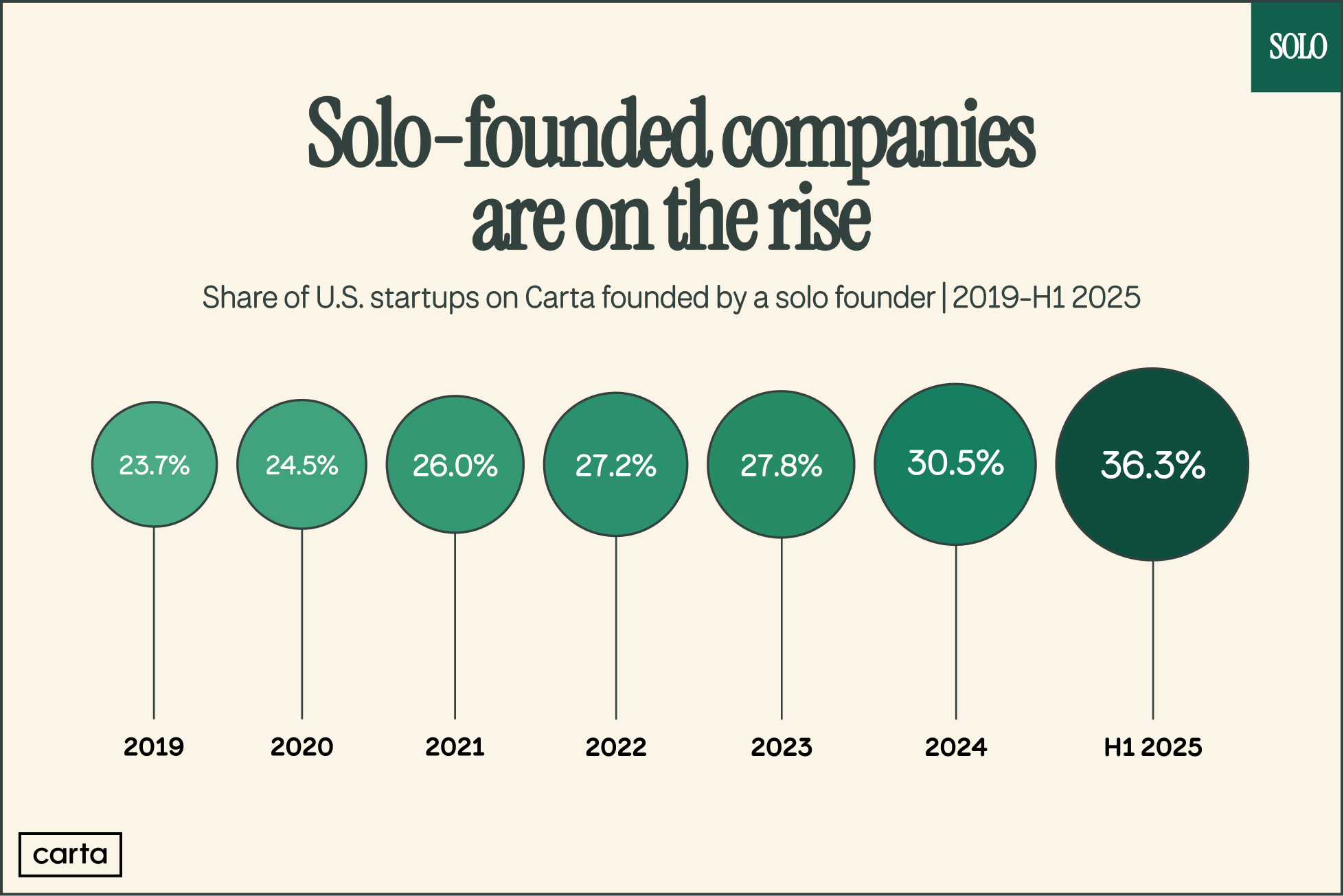
A funding gap, however, remains. While 30% of companies founded in 2024 were solo-led, solo founders captured only 14.7% of the cash raised in priced equity rounds that year (Carta, as of 2024). Investors still favor multi-founder teams. At exit, though, the picture flips: median founder ownership is 75% higher for solo founders than for lead founders in multi-founder companies (Carta, 2019–H1 2025). The leaner you start, the more of the upside you tend to keep.
Zoom out to the whole economy and there are 29.8 million non-employer businesses in the U.S., generating $1.7 trillion in combined revenue (U.S. Census Bureau, as of 2023; reported by Fortune). One-person-scale business is no longer a footnote.
Why one person can now compete
The driver is a collapse in cost structure. An analysis published by Taskade puts a solo founder's full AI tool stack at roughly $300–500 per month. Doing the same work with a team of about ten would cost $80,000–120,000 a year in salaries alone — a 95–98% reduction (Taskade, as of 2026). With fixed costs gone, operating margins can reach 60–80%, against 10–20% for a business carrying headcount.
The bullish voices are loud. Anthropic CEO Dario Amodei put the probability of a one-employee, billion-dollar company emerging during 2026 at 70–80% (Taskade, statement as of 2026). At CES 2025, NVIDIA's Jensen Huang argued that AI lets each individual carry the productivity of a whole department — in his words, "every employee can be a department" (CES 2025). Even Paul Graham, long an advocate of co-founders, has reportedly softened his stance on solo founding.
What the revenue actually looks like
Marquee examples abound. Pieter Levels runs a portfolio of products at $3–5M a year with zero employees. Danny Postma's HeadshotPro reached $3.6M ARR; Marc Lou's ShipFast crossed $1M in 2024. The headline case is Base44, built largely single-handedly by Maor Shlomo: $1.5M in revenue in a single month, sold to Wix for $80M in June 2025 (Fortune, reported May 2026).
| Founder | Business | Scale (as of) | Employees |
|---|---|---|---|
| Pieter Levels | Nomad List / PhotoAI, etc. | $3–5M revenue | 0 |
| Danny Postma | HeadshotPro | $3.6M ARR | 0 |
| Marc Lou | ShipFast, etc. | $1M+ revenue (2024) | 0 |
| Maor Shlomo | Base44 | Sold for $80M (June 2025) | mostly solo |
But the full picture wears a different face. Taskade's data shows most solo founders earn $3,000–5,000 a month, and only 2–3% ever cross $1M in ARR (Taskade, as of 2026). The "one-person billion-dollar company" is genuinely within range, but it sits at the far tail of the distribution. For most people, the reality is a small, muscular business that supports a life.
The cost of leaving it all to AI
Behind the glamour, practitioners are naming a different risk. In Fortune's reporting, J.P. Eggers, a professor at NYU's Stern School of Business, captured the danger of delegating execution to AI:
"You're kind of taking it on faith that what the AI is producing is pretty good."
In other words, you are trusting — almost on faith — that the AI's output is good enough. The line cuts to the structural weakness of solo work: with no colleague to check you, errors ship straight to the outside world.
Fortune lists several traps. As you scale, compute bills can balloon into the hundreds of thousands of dollars. AI cannot be left alone; it demands constant oversight and correction. And telling good output from bad ultimately requires deep domain expertise — AI does not make expertise unnecessary, it multiplies the productivity of those who have it. There is also the structural concern that wealth concentrates in a handful of individuals.
What solo operators should keep in view
So how do you pull this trend into your own business? Holding a few principles beats memorizing a checklist.
First, separate the work you hand to AI from the work you keep. Generation, drafting, and routine processing are faster with AI, but deciding what to build, owning the first point of contact with customers, and signing off on quality stay with you. Eggers' warning bites exactly here: outsource what you cannot verify, and a single error can take your credibility down with it.
Second, put the first-hand knowledge and expertise only you can offer at the core of the business. Anything AI can reproduce cheaply and quickly, competitors will soon reproduce at the same cost. The edge comes from what AI cannot hold — field insight, customer understanding, accumulated judgment. Anyone can buy a $300 tool stack; no one can buy your expertise.
Third, measure the business by margin and repeatability, not by a flashy exit. As the median revenue shows, most one-person companies are small. That is precisely why the realistic path to winning is keeping fixed costs near zero, holding high margins, and building revenue that compounds month after month.
The meaning of "scale" is changing
The rise of solo entrepreneurship signals the end of an era that measured a company by headcount. If you can grow revenue and profit without adding people, "scale" stops meaning the number of heads and starts meaning the total value one person can move. Whether Amodei's "70–80%" comes true remains to be seen. But the structure itself — small teams generating large value — has already passed the point of no return. The question is no longer "how many to hire," but "what do I keep, and what do I hand to AI?" For your business, where would you draw that line?
Key takeaways
The solo-founded share rose from 23.7% in 2019 to 36.3% in H1 2025 (Carta), and the U.S. counts 29.8M non-employer businesses generating $1.7T in revenue (Census Bureau, as of 2023). A full AI tool stack runs $300–500/month, enabling a 95–98% cost reduction versus a ten-person team and 60–80% margins (Taskade); Base44 went from $1.5M in a month to an $80M sale (Fortune, May 2026). Yet only 2–3% of solo founders cross $1M ARR, and over-delegating to AI carries the danger of "taking on faith that the output is good." The keys: decide what you keep versus what you hand to AI, and place your own irreplaceable expertise at the core.
PR

Sources
This article was independently written and edited by the Business Age Editorial Team based on the multiple verified sources below. See each source for full details.
- Carta / Solo Founders Report 2025Read the original →
- FortuneRead the original →
- TaskadeRead the original →
PR
Related
Related articles

The Real Map of AI Side-Income: The Skills That Doubled, and Why Humans Still Win

Making Money with AI in 2026: How Solopreneurs Build a $6,000–$14,000 Income Stack

Can a Newsletter Pay the Bills? What Substack's Numbers Reveal

The Real Math of Selling Digital Products: What Gumroad's Numbers Reveal

Is Faceless YouTube Over? The Reality After the Rule Change

Side-Job Acceptance Hits a Record—Yet ¥54K a Month: How AI Is Raising the Ceiling on "Earning Solo"
Categories
Browse other categories





Get the latest business methods, first.
We share new articles and notable tools and trends on social.